
A First-Timer’s Guide to Cape Verde: What to Know Before You Go
The archipelago most travelers overlook has been waiting. Here is how to arrive prepared.
By Lindsay Bourdeau | Published on May 21, 2026

Wild coastline in Santiago, Cape Verde. Photo: Shutterstock
Most people who have not been to Cape Verde carry the same assumptions: that it is difficult to reach, that its beaches belong to a lesser category than the East African islands everyone already knows, and that it is a destination you work up to rather than one you prioritize. All three assumptions are wrong. Cape Verde sits off the western coast of mainland Africa, surrounded by the Atlantic Ocean. And, the Atlantic, which is not generally known for its visual drama, produces water here that competes directly with Zanzibar, the Seychelles, and anything the Caribbean has to offer. That surprise is usually the first thing first-timers mention when they come back.
This guide covers everything else they wish they had known before they went.
Getting There Is Not the Problem You Think It Is

Amílcar Cabral International Airport. Photo: Cabo Verde Airports
The most persistent misconception about Cape Verde is that it is hard to get to. It is not hard to get to. It requires some planning, which is not the same thing.
From the United States, most routes involve a layover — typically in Lisbon — and a total travel time ranging from 12 to 24 hours depending on connections. From Europe, the journey is considerably shorter: four to seven hours on a direct flight. Neither of these figures is unusual for an African destination. Travelers who think nothing of the journey to Ghana, Kenya, or South Africa routinely cite Cape Verde’s travel time as a deterrent, which does not hold up to comparison. The distance is the same. The logistics are no more complicated. The barrier is perception, not geography.
Sal and São Vicente have the best-connected international airports in the archipelago. Most first-timers land in Sal. From there, the islands are within reach.
When to Go
Cape Verde has two seasons. The dry season runs from November to July and is the window most visitors should be working with. March sits comfortably inside this window and is an excellent time to visit — the weather across Sal, São Vicente, and Santo Antão is reliable, the light is good, and the islands are operating at full capacity without the peak-season crowds of December and January.
The rainy season runs from August to October. Heavy rainfall during this period is likely enough that most travelers should plan around it rather than through it. One weather phenomenon worth knowing before you go: the Bruma Seca. Between November and March, the Barlavento islands — the northern group, which includes São Vicente — can experience a dry dusty haze carried by winds from the Sahara Desert. At its most severe, it causes flight delays. It is worth tracking conditions in the weeks before departure, particularly if your itinerary involves tight connections between islands.
The same period brings strong winds to the Barlavento islands, which makes it peak season for kite surfers and a factor worth noting for anyone planning extended beach time in Sal.
Getting Around

Woman speaking to an aluguer driver. Photo: Jean-Baptiste Neau
Within each island, two forms of transport cover most needs. Regular taxis are the most expensive option and the most convenient. Aluguers — shared taxis holding ten to twelve passengers — are what locals use, and they are significantly cheaper. They operate on a loose timetable from central transportation hubs but typically depart once full, which means delays are possible. Timetables are not always easy to find online; the most reliable approach is to ask at the airport on arrival, at your accommodation, or at the hub itself.
Between islands, internal flights are the fastest option and cover the most frequently visited destinations well. Sal and São Vicente, both with international airports, are the best-connected points in the archipelago. Some routes experience unexpected cancellations or delays — Boa Vista in particular has a reputation for this — so it is worth tracking any flight changes closely if that island is on the itinerary.
Santo Antão has no airport. The only way to reach it is by ferry from Mindelo in São Vicente — a one-hour crossing that is comfortable under normal conditions but subject to cancellation in rough seas. Ferry schedules should be monitored for the same reason as internal flights.
Language
The official language of Cape Verde is Portuguese. In daily life, most locals speak Crioulo, a Portuguese-based Creole specific to the islands. On the more touristic islands — Sal and São Vicente — English is widely spoken, and French gets you further than expected. Santo Antão is less visited and less linguistically diverse; Crioulo is the dominant language there, with French useful as a secondary option. Portuguese and English alone will be less effective on that island than on the others.
What to Pack
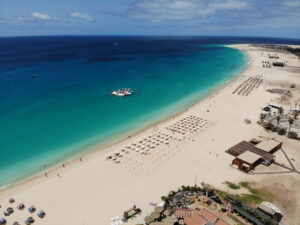
Aerial view of Santa Maria beach. Photo: Shutterstock
One item that most first-timers do not think to bring in sufficient quantity: sunscreen with an SPF of 50 or higher, and enough of it to reapply consistently throughout the day.
Sal in peak season is very hot, humid, and windy. The combination causes sand to rise, which accelerates sunburn significantly. The exposed areas — eyelids, cheeks, lips — are the most vulnerable. This is not a standard beach-holiday warning. The conditions in Sal are more intense than most travelers are prepared for, and the consequences of underpreparing are immediate and unpleasant. Pack accordingly and reapply more often than feels necessary.
Which Island — and How Many
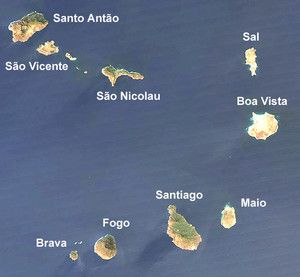
Cape Verde Islands
The single most common mistake first-timers make in Cape Verde is visiting only one island. The archipelago is ten islands, and no single one of them gives an accurate picture of the whole. São Vicente and Sal feel like different countries. Santo Antão feels like a different planet.
If the itinerary allows for one island only, São Vicente is the strongest choice. It offers culture, music, food, nature, and nightlife in a combination that covers more of what Cape Verde actually is than any other single island. If time allows for a second, the ferry from Mindelo to Santo Antão takes one hour and delivers one of the most dramatic landscapes in the entire archipelago — mountains, valleys, hiking trails, and a quality of village life that is increasingly rare in places that have been on the tourist radar for any length of time.
Sal is the right choice for travelers who know they want a beach holiday with Caribbean energy and a serious nightlife scene. It is not the right choice for travelers who want to understand Cape Verde. It is the right choice for travelers who want to enjoy it on very specific terms — and on those terms, it delivers completely.

Santa Maria beach at sunset. Photo: Shutterstock
For travelers with two to three islands and one week, the São Vicente and Santo Antão combination covers the most ground. Research transport connections between your chosen islands before departure, and build flexibility into the schedule. Delays happen. The islands are worth the patience they occasionally require.