
Cape Verde’s Most Powerful Export Isn’t Tourism. It’s Morna
The music that built a nation’s identity, earned UNESCO recognition, and turned a barefoot singer from São Vicente into a global icon. Cape Verde morna music is more than a genre — it is part of the country’s cultural identity.
By Lindsay Bourdeau | Published on May 21, 2026

Mindelo at blue hour. Photo: Shutterstock
Morna is Cape Verde’s defining music. It predates the tourism industry, the independence movement, and almost everything else the archipelago is known for internationally. UNESCO recognized it as an Intangible Cultural Heritage of Humanity in 2019. Cape Verdeans have known its value considerably longer than that. For many visitors, the introduction comes before they even arrive — Cesária Évora’s music travels far enough that first encounters happen in markets in Australia, on playlists in New York, in restaurants in Paris. By the time most curious travelers land in São Vicente, they already know what they are looking for.
What It Sounds Like
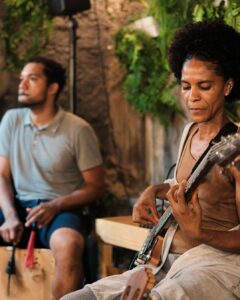
Woman playing guitar at Casa Tchicau. Photo: Casa Tchicau
Morna is slow, smooth, and slightly melancholy. Cape Verdeans call it música rainha — queen music. The closest reference point for a first-time listener is smooth jazz: melodic, unhurried, built for an evening rather than a dance floor.
Its roots go back to an ancestral African rhythm called Lundum or Landú. The earliest performances are traced to enslaved women on the islands in the early eighteenth century — songs about daily life and loss. The Cape Verde islands served as a trading post during the transatlantic slave trade, and that history is embedded in the music. Over time the themes shifted to migration, love, nostalgia, and the sea. The Atlantic that surrounds Cape Verde on every side runs through Morna the way the Mississippi runs through the blues — not as a backdrop but as a subject.
Cesária Évora
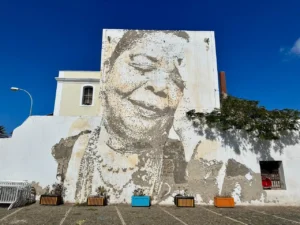
Mural of Cesária Évora in Mindelo. Photo: Alexandre Farto
No name in Cape Verdean music carries more weight. Cesária Évora performed barefoot — a deliberate act of solidarity with those who could not afford shoes — and she took Morna from a genre known almost exclusively within the archipelago to stages across Europe and the Americas. She rose to international prominence late in life and shared the global stage with artists including Celia Cruz. What she did for Cape Verde’s cultural profile no tourism campaign has matched since.
She is everywhere in Mindelo. Murals of her face appear throughout the city. Streets carry references to her. Cape Verdeans celebrate her loudly and without reservation — not as a historical figure to be preserved but as a presence that still shapes how the island moves and what it plays at night. Visiting São Vicente without encountering her, in some form, is not really possible.
Where to Hear It

Rooftop dining at night at Casa Tchicau. Photo: Casa Tchicau
Morna is not hard to find in São Vicente. It surfaces in bars, restaurants, and side streets without much effort. The venue that keeps coming up is Casa Tchicau — a Black woman-owned restaurant in Mindelo serving a four-course traditional Cape Verdean menu that changes daily, with live Morna every night. It is a hidden gem in the truest sense: known to those who looked, invisible to those who did not. The food and the music arriving together in a single sitting is not incidental — it reflects how Morna actually lives in Cape Verdean culture, woven into the evening rather than performed for an outside audience.
Other reliable options in Mindelo include Casa da Morna by Buxa, Le Metalo Restaurante Musical, and Jazzy Bird Bar Pub. On Sal, Morna is harder to find — the island runs on higher-energy music and a party culture that is not built for it. São Vicente is where it belongs and where it is best experienced.
Why It Matters

Mindelo at night. Photo: Shutterstock
Cape Verde is celebrated for its beaches, its salt flats, its hiking trails. Those things are all worth the trip. But the music is what stays. Hearing Morna live in a small room in Mindelo — a musician a few meters away, the city outside doing what it does every night — is one of those experiences that changes how a destination sits in the memory afterward.
Cape Verde’s most powerful export is not its beaches or its salt. It is a genre of music that is centuries old, carries the weight of a specific and difficult history, and still sounds, more than anything else, like a reason to stay.