
The Nigerian Coast: Beaches and Islands Beyond Lagos
Eight hundred and fifty kilometers of Atlantic coastline, and the world only talks about one city. It is time to change that.
By Amina Mamaty l Published on April 27, 2026
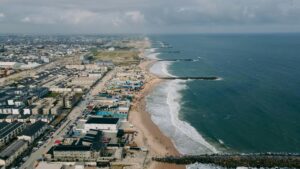
Lagos coastline, Elegushi beachfront. Photo: Shutterstock
Lagos has its beaches — Tarkwa Bay, Ilashe, La Campagne Tropicana with its 65 acres of palm-fringed Atlantic shoreline where the ocean meets the lagoon and the lagoon meets a mangrove forest that feels entirely removed from the city an hour behind you. These are not small pleasures. But to stop there is to misread Nigeria’s coastline entirely. The country runs from the Bight of Benin in the west to the Cross River estuary in the east, and between those two points lies some of the most dramatically varied coastal geography in West Africa — islands accessible only by water, beaches so wide and untouched they feel personally owned, and river deltas that dissolve the line between land and sea in ways that have no equivalent elsewhere on the continent.
The travelers who know this are, for now, mostly Nigerians. That will not always be the case.
Ilashe and La Campagne Tropicana, Lagos — The Known Starting Point
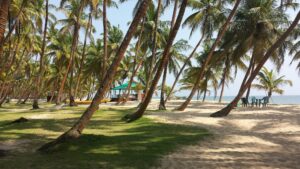
Beach at La Campagne Tropicana. Photo: La Campagne Tropicana Beach Resort
Any honest account of Nigeria’s coastline begins here, not because these are the most extraordinary beaches in the country, but because they set the standard that makes everything else legible. Ilashe is a private island just fifteen minutes by speedboat from Victoria Island — quiet, palm-lined, entirely without the noise of the mainland. La Campagne Tropicana sits further east along the Lekki corridor, where the Atlantic presses up against Ikegun Lake and a working mangrove forest closes in from behind. The resort offers over 65 acres of palm-fringed white sand beach, river and mangrove forest, with overwater chalets built directly on the lagoon and a cultural sensibility that is distinctly and deliberately Nigerian. These are the beaches that establish the expectation. What follows exceeds it.
Bonny Island, Rivers State — The Island at the Edge of the Delta
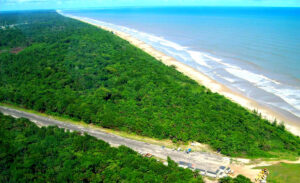
Bonny Island in Port Harcourt. Photo: Rex Clarke Adventures
Bonny Island is situated at the southern edge of Rivers State in the Niger Delta, surrounded on the west and south by long stretches of beaches. Getting here requires intention — the island is accessible by ferry from Port Harcourt, or by the small airstrip that now receives domestic flights from Lagos and Abuja. That barrier is precisely why it remains what it is: a place where the beaches belong to the people who live on them, and where the infrastructure has not yet standardized the experience into something recognizable.
Finima Beach is situated within the Finima community, lying near areas of mangrove swamp and tropical rainforest that characterize the local ecology, part of the wider coastal landscape of the Niger Delta region. The beach itself is long, sandy, and largely to itself outside of the festive season when Nigerians arrive in their thousands for the famous Finima beach carnivals on the 26th through 31st of December. Adjacent to it, the Finima Nature Park covers approximately 1,000 hectares of freshwater swamp forest and harbors pygmy hippos, crocodiles, monkeys, and numerous bird species. This is not a resort experience. It is something considerably more interesting — an island with a thousand years of recorded history, a coastline that has barely been written about in travel media, and a natural environment that rewards the traveler who shows up without a script.
Ibeno Beach, Akwa Ibom — West Africa’s Longest Shoreline
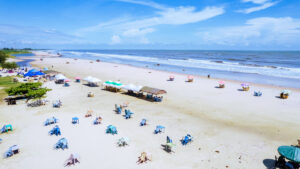
Ibeno Beach, Nigeria’s longest shoreline. Photo: Shutterstock
The superlative is real and almost entirely unacknowledged outside Nigeria. Ibeno Beach stretches for about 30 kilometres along the Atlantic coastline of Akwa Ibom State and is considered the longest sand beach in West Africa. For context, that is a beach longer than the entire coastline of some Caribbean islands, running in an unbroken line of pale sand from Ibeno town toward James Town, with the Qua Iboe River estuary cutting through at its heart and the gas flares of offshore oil platforms visible on the horizon at night — an image so specific to this coast that it has no equivalent anywhere else.
The beach is less crowded compared to other popular beaches in Nigeria, making it ideal for a peaceful retreat, with golden sand, clear waters, and lush surrounding vegetation. The base for visiting is Uyo, Akwa Ibom’s capital, approximately 40 minutes away — a city with proper hotels, good restaurants, and an ease of navigation that surprises first-time visitors. The Ibom Hotel and Golf Resort provides the kind of infrastructure that makes the rawness of Ibeno not an inconvenience but a deliberate contrast: you stay well, you travel simply, and you arrive at a beach that has been the cultural and spiritual heartland of the Ibeno people since at least 1200 BC. The beach comes alive in December, when locals say “Ibeno never sleeps,” with fresh seafood, live music, and the full weight of a coastal community celebrating itself.
Calabar and the Cross River Coast — Where Nigeria Meets the Rainforest
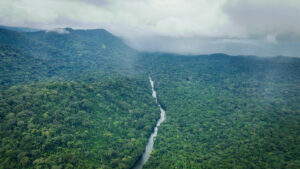
Oyi River transecting Okwangwo Division of Cross River National Park. Photo: Adedotun Ajibade
Calabar operates at a different frequency from Lagos or Port Harcourt. A port city near the Cameroon border renowned for its rich history, cultural diversity, and natural beauty, Calabar retains much of its historical charm and has become an increasingly popular tourist destination. The waterfront here is the Marina Beach — calmer and more contemplative than the open Atlantic beaches further west, with the Cross River widening toward the estuary and the city rising behind it in green layers. Boat cruises on the river are a legitimate activity rather than a tourist concession, threading through one of the most biodiverse river systems in Nigeria.
What sets this stretch of coast apart is context. The Cross River National Park begins barely an hour’s drive north of the city, home to Nigeria-Cameroon chimpanzees, African forest elephants, drills, and some of the last Cross River gorilla populations remaining on earth. The Calabar Carnival every December has grown into one of the largest street festivals on the continent. And the city itself — described for years as the cleanest in Nigeria, built around wide avenues and a functioning waterfront — offers a quality of life that many Nigerian cities are still working toward. A traveler who bases here and moves between the coast, the river, and the forest will cover more genuine ecological and cultural range in four days than most destinations can offer in a week.
Getting There and Moving Between
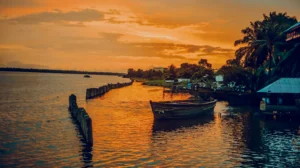
Koko River at sunset in Delta State. Photo: Shutterstock
Nigeria’s domestic flight network connects Lagos, Abuja, Port Harcourt, Calabar, and Uyo with enough frequency to make a multi-stop coastal journey practical. Port Harcourt is the gateway for Bonny Island — ferry connections run regularly from the city’s waterfront. Uyo is the base for Ibeno, reachable by road in under an hour. Calabar has its own airport with direct connections to Lagos. The coastline is navigable. It simply requires the kind of planning that, until recently, travelers were not being given permission to attempt.
That permission starts here.
La Campagne Tropicana