
Inside Africa’s Biggest Fashion Week: Lagos Fashion Week
Why Lagos Fashion Week is no longer a regional event — and why the global fashion industry is paying attention.
By Ufeli Ani-Olopade | Published on May 20, 2206
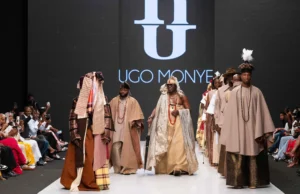
Photo: Lagos Fashion Week
There is a version of Lagos Fashion Week that exists in the imagination of people who have never been: emerging, promising, catching up. That version does not survive contact with the real thing. What actually happens in Lagos each year is something more specific and more confident than the word “emerging” allows for. It is a fashion week that has decided, at an institutional level, not to replicate what exists elsewhere. The result is something the traditional fashion capitals are not producing.
The Atmosphere
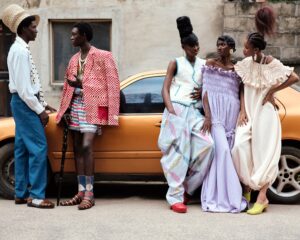
Photo: Lagos Fashion Week
The energy inside Lagos Fashion Week is not manufactured. That distinction matters. Fashion weeks in established markets have learned to perform excitement; Lagos Fashion Week generates it organically — from the designers, the buyers, the stylists, the creatives, all of whom arrive moving with visible intention. The boldness is not decorative. Attendees are not dressing for approval. They are dressing to communicate something, and the difference between those two impulses is legible in every look that walks through the door.
What makes the setting unusual is its permeability. The city does not stay outside. Lagos bleeds directly into the experience — its rhythm, its intensity, its layering of old and new — and the creative work on display absorbs all of it. The result is a fashion week that feels less like an industry event and more like a live expression of a city mid-transformation.
Beyond the Runway

Photo: Lagos Fashion Week
The runway is one layer. It is not the whole story. Across the city during Lagos Fashion Week, pop-ups showcase designers who are not yet on the official schedule. Brand activations pull the conversation into unexpected spaces. Nightlife extends the momentum well past midnight, and what happens in those rooms — the introductions, the collaborations, the arguments about where Nigerian fashion is going — is as consequential as anything that happens on a stage.
Street style operates as its own parallel fashion week. It is arguably more daring than the runway, less mediated, more immediate. Lagos during that week is not a backdrop. It is a participant.
What Makes It Nigerian
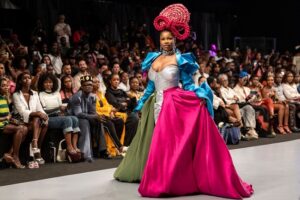
Nigerian influencer, Anita Natacha Akide. Photo: Lagos Fashion Week/ Olympia de Maismont
The designers who stay with you after Lagos Fashion Week are not the ones most legible to a Western eye. They are the ones for whom storytelling and technical execution are inseparable — traditional textiles reinterpreted without apology, silhouettes that do not reference Paris or Milan because they do not need to. The colors, the proportions, the music that accompanies the shows all reflect a creative ecosystem that is rooted and forward-looking simultaneously, one that has made a deliberate choice not to seek validation from outside itself.
That independence is what makes Lagos Fashion Week distinctly Nigerian. It is not an emerging market catching up to an established standard. It is a different standard, operating on its own terms.
Why It Matters Now

Photo: Lagos Fashion Week
Nigeria is not on the periphery of the global fashion conversation. That positioning, which once required arguing for, has become self-evident to anyone paying attention. From music to fashion, Nigerian creatives are shaping trends rather than following them, and Lagos Fashion Week is the most concentrated expression of that shift in a single week.
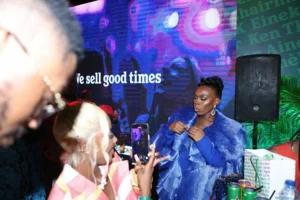
Photo: Lagos Fashion Week
What the event reflects is an industry building its own infrastructure — talent nurtured locally, creativity exported globally. The fashion conversation is decentralizing, and Lagos is not simply part of that redefinition. It is driving it.
For anyone who has not yet considered attending: Lagos Fashion Week is not a replication of something that exists elsewhere. It is an immersion into a creative ecosystem that is building the future of the industry in real time. That is not something the traditional circuit is currently offering.