
Mongolia Travel Guide: What to Know + Festivals You Can’t Miss
Mongolia is one of the most underestimated countries on earth — and travelers who’ve been there will tell you exactly that.
By Amina Mamaty | Published on May 25, 2026
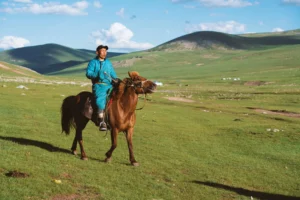
Local on horseback. Photo: Shutterstock
Most travelers picture Mongolia as a place for a certain kind of person: rugged, gear-heavy, indifferent to comfort. That picture is wrong on at least three counts. Mongolia is vast, yes — the eighteenth largest country in the world, with a population of just three million people spread across a landscape that shifts from alpine forest to desert to open steppe without warning. But it is also a country of extraordinary hospitality, surprising cosmopolitan energy in its capital, and a cultural calendar that rivals anywhere in Asia. The traveler who writes Mongolia off as too remote, too harsh, or too basic is simply the traveler who hasn’t planned carefully enough.
Planning, as it turns out, is everything here.
Before You Go
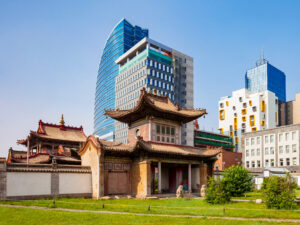
Ulaanbaatar cityscape. Photo: Shutterstock
Ulaanbaatar will surprise you. The capital is genuinely cosmopolitan — good restaurants, a real nightlife scene, world-class museums, and a creative class that has no interest in being overlooked. Start here, absorb it, and then let the steppe recalibrate everything you thought you understood about Central Asia. The contrast between city and countryside is not a flaw in the travel experience — it is the travel experience. One day you are eating at a Korean-Mongolian fusion restaurant in the capital; three days later you are a guest in a nomadic family’s ger with no phone signal and no road in sight. Both are Mongolia.
Those distances matter more than most travelers account for. Outside Ulaanbaatar, infrastructure essentially disappears — paved roads give way to dirt tracks, phone signal becomes a luxury, and driving between regions can mean eight or ten hours across open terrain with nowhere to stop. This is not a country you improvise. Flights fill up fast, especially around major festival seasons, and accommodation options in remote areas are limited to whatever ger camp or nomadic family will have you. Book well in advance, build buffer days into your itinerary, and treat the journey between places as part of the destination rather than an inconvenience.
Visa requirements are manageable with advance planning — most nationalities can secure a Mongolian visa without difficulty, but leaving it until the last minute risks complications. Check requirements early, cross-reference with your country’s embassy, and don’t assume the same rules that applied last year still apply.
When to Go
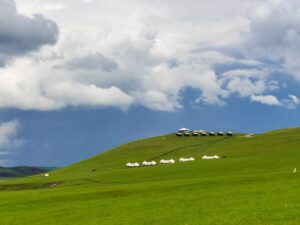
Fall Mongolian landscape. Photo: Shutterstock
The honest answer is July through August, with a strong case for late August in particular. July brings Naadam — Mongolia’s greatest festival — along with the green steppe at its most alive. By mid-August the summer heat begins to ease, the landscape shifts toward gold, and the crowds thin out. Late August into early September is arguably Mongolia at its most beautiful: warm enough to travel comfortably, cool enough at night to make a ger’s central stove feel like a gift, and visually dramatic in a way that photographs can’t fully prepare you for.
Winter travel is not impossible — it is, in fact, spectacular for those willing to dress for -30°C — and February brings one of Mongolia’s most surreal events (more on that shortly). But for a first visit, summer into early fall is the window that makes everything easier.
The Festivals
Naadam — July 11–13, Ulaanbaatar and nationwide
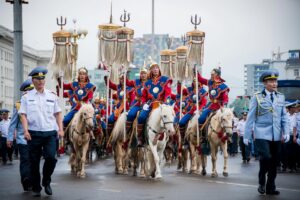
Naadam festival opening ceremony. Photo: Shutterstock
Naadam is Mongolia’s national soul made visible. Held every year on July 11th to mark the anniversary of the 1921 revolution, it is a UNESCO Intangible Cultural Heritage and the country’s most important celebration — a fact Mongolians take seriously enough that the entire nation takes a public holiday and the winners of each sport become de facto national icons.
The festival centers on the Three Games: wrestling, horse racing, and archery. These are not exhibition events — they are fiercely competitive, deeply traditional, and cheered with the kind of collective passion that reminds you sport was once inseparable from survival. Mongolian wrestling is untimed and unweighted, meaning competitors of any size face each other until someone touches the ground. The horse races are long-distance events run by child jockeys as young as six, with the winning horse — not the rider — receiving the greatest honor. Archers compete with traditional bows at distances that would humble most modern athletes.
The main event in Ulaanbaatar is grand and theatrical, complete with an elaborate opening ceremony. But travelers willing to seek out a local, rural Naadam in one of Mongolia’s provinces will find something more intimate — smaller crowds, closer access to the athletes, and a version of the festival that feels genuinely communal rather than performed for an audience. One logistical note: book flights and accommodation for Naadam at minimum six months in advance. This is not an exaggeration. Seats fill.
The Golden Eagle Festival — First weekend of October, Bayan-Ölgii Province
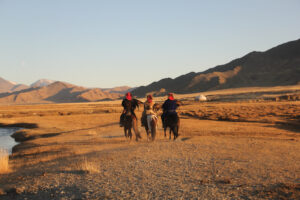
Golden Eagle hunters on horseback with eagles on arm. Photo: Shutterstock
Held each year in the far western province of Bayan-Ölgii — 1,600 kilometers from Ulaanbaatar, in the shadow of the Altai Mountains — the Golden Eagle Festival celebrates the ancient Kazakh tradition of hunting with trained golden eagles, a practice that UNESCO recognized as Intangible Cultural Heritage in 2010.
The setting alone is worth the journey: dark, rocky mountain terrain under a wide October sky, Kazakh hunters riding in on horseback with eagles perched on their arms, dressed in the elaborate traditional costume that has been passed down through generations. Competitions test the eagles on speed, agility, and accuracy — how quickly they respond to their hunter’s call, how precisely they descend from a cliff onto a target. There are also horse races, a goatskin tug-of-war on horseback, and a parade through Ölgii that turns the provincial capital briefly into one of the most visually extraordinary places on earth. Domestic flights to Bayan-Ölgii are limited and book out fast during festival season — arrange travel at least four to five months ahead.
For those who can’t make the October dates, the Altai Eagle Festival held in late September in Altai Soum is a smaller, quieter alternative with fewer crowds and a more intimate look at the eagle hunting community.
The Thousand Camel Festival — Late February to early March, Gobi Desert
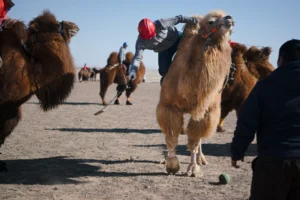
Thousand Camel Festival in the Gobi Desert. Photo: Shutterstock
Yes, it is February. Yes, the Gobi Desert in February can reach -30°C. And yes, it is absolutely worth it — because nowhere else on earth will you watch a camel beauty pageant on a snow-dusted desert floor while nomadic herders in full traditional dress compete in camel polo, camel racing, and a team challenge that involves catching an untrained camel, shearing its wool to make a halter, and loading it with luggage against the clock.
Founded in 1997 by local herding communities in Umnugovi Province to protect the endangered two-humped Bactrian camel, the festival has grown into a genuine winter institution — one that broke a Guinness World Record in 2016 when 1,108 camels raced across fifteen kilometers of frozen Gobi. The camels are at their most visually dramatic in winter, wrapped in thick shaggy coats that make them look like creatures from another era entirely. Pack serious cold-weather gear, book accommodation well in advance, and arrive willing to be spectacularly uncomfortable in the best possible way.
The Experience That Defines It All
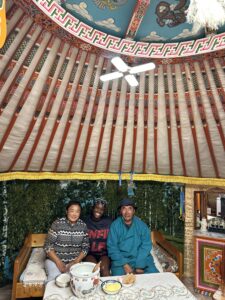
Nomadic family welcoming a traveler into their ger. Photo: Young International
Beyond the festivals, beyond the ger stays and the landscape and the food, the experience most travelers carry home from Mongolia is simpler than any of that: being welcomed into a nomadic family’s home without expectation or agenda. A bowl of suutei tsai placed in your hands before you’ve had a chance to ask for anything. Children watching you from across the ger with complete, unhurried curiosity. A family that measures hospitality not by what they can offer but by the fact of the offering itself.
Mongolia will surprise you at every scale — from the sweep of the steppe to the warmth of a single conversation. Plan carefully, arrive with patience, and leave room for the country to exceed everything you came prepared for.