
Staying in a Ger in Mongolia: From Nomadic Camps to Luxury Stays
The world’s oldest form of hospitality hasn’t changed much in a thousand years — and that’s exactly the point.
By Amina Mamaty | Published on may 25, 2026
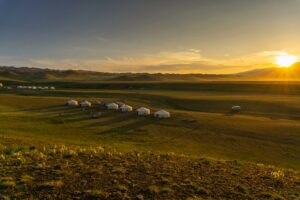
Ger camp against the open Mongolian steppe. Photo: Shutterstock
What Is a Ger?
A ger is a portable, circular dwelling that has sheltered Mongolian nomadic families for thousands of years. Constructed from a latticed wooden frame, felt insulation, and a white canvas exterior, it can be assembled and disassembled by a family in under an hour — a necessity for people who follow their livestock across the seasons. Think of it as the original luxury suite: engineered by centuries of necessity, warmed by a central iron stove, and open to the sky through a circular crown at the top that doubles as a window to the stars.
Mongolia is widely known for its ger culture, but what many travelers don’t realize is that the country has quietly evolved into one of the most compelling destinations in Central Asia — for every kind of traveler. Whether you’re happy to share facilities under an open sky or you refuse to compromise on comfort, Mongolia has a ger with your name on it.
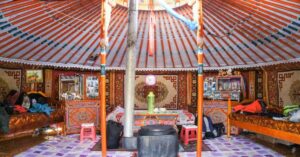
Inside of a ger. Photo: Young International
Every element inside a ger has meaning. The left side belongs to women, the right to men, and the northern wall — the place of honor directly opposite the door — is where the family altar sits. Guests always move clockwise. The door of a ger always faces south, and this is more than tradition. On the open steppe, where landmarks are few and GPS is a recent arrival, the orientation of a ger’s door has long served as a natural compass. Travelers who understand this can orient themselves in any direction simply by spotting a ger in the distance.
At the center sits an iron stove, fired with wood or dried animal dung — cow dung burns slowly and efficiently and has kept Mongolian families warm through some of the coldest winters on earth. The stove’s pipe threads upward through the toono, the circular crown opening at the top of the ger. That opening is more than architectural: it functions as a clock. As the sun moves across the sky, light enters through the toono at a different angle each hour, tracking time across the interior floor. Nomadic families have read this living sundial for generations. And stepping over the threshold? Never on it — that is one of the first rules of ger etiquette you will learn, and one of many that make staying in one feel like a cultural education in the round.
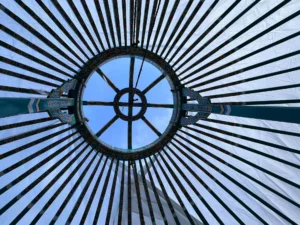
Close-up of a toono from below looking up. Photo: Shutterstock
Two Experiences, Two Scales
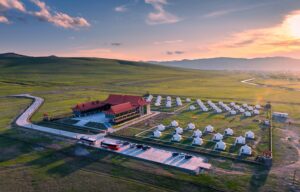
Exterior of Secret of the Silk Road camp. Photo: Secret of the Silk Road Camp
For travelers visiting Karakorum — the ancient 13th-century capital of the Mongol Empire — Secret of the Silk Road camp sits just three kilometers from Erdene Zuu, the country’s oldest Buddhist monastery. The camp was designed to echo the architecture of Ögedei Khan’s legendary palace, and the setting rewards a slower pace: mornings with views across the surrounding steppe, evenings of traditional Mongolian song and dance performed by staff, and days spent wandering ruins and monasteries that most of the world has never heard of. Deluxe gers with ensuite bathrooms run approximately 400,000 MNT (roughly $115 USD) per night. Standard gers with shared facilities are available at a lower price point. Either way, the experience is more grounded than remote — and deliberately so.
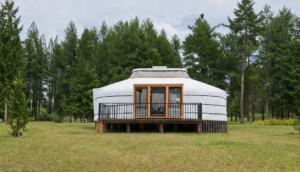
Double Lake by Toilogt’s exterior. Photo: Young International
At the luxury end of the spectrum, Double Lake by Toilogt raises the ger to something cinematic. Situated on the edge of twin glacial lakes in the remote Khövsgöl region of northern Mongolia, the camp is proof that glamping doesn’t have to mean compromise — it can mean waking to a landscape so untouched it feels borrowed from another century. For travelers who want the full story on what luxury looks like at the edge of the world, read our full stay feature on Double Lake by Toilogt.
The Table
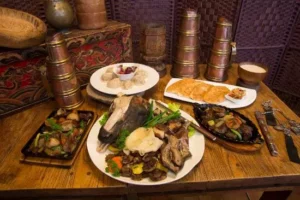
Mongolian food spread with buuz, suutei tsai, and airag. Photo: Young International
Mongolian food is an honest reflection of nomadic life: meat, dairy, and starch, built for survival on the open steppe. Airag — fermented mare’s milk, made from the milk of horses — is an acquired taste that most visitors try once and remember forever. Suutei tsai, salted milk tea, is offered constantly and everywhere, a gesture of welcome as much as a drink. Buuz, plump steamed dumplings filled with minced mutton, arrive at most meals and are best eaten with your hands. Tsuivan, stir-fried noodles tangled with meat and vegetables, is the kind of dish that fills you the way a full day on horseback requires. And khuushuur — golden, slightly crisp fried meat pastry — is the snack you’ll find yourself reaching for whenever it appears.
When to Go
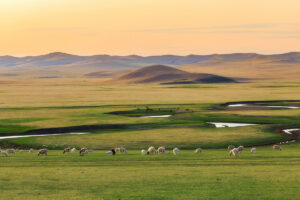
Mongolian golden steppe landscape in late summer or early fall. Photo: Shutterstock
Late summer into early fall is Mongolia at its most painterly. The steppe shifts from green to gold, the light turns amber in the afternoons, and the summer crowds of Naadam festival season have thinned. Temperatures stay manageable during the day while dropping enough at night to make the ger’s central stove feel like the luxury it genuinely is. It is also one of the best windows to encounter nomadic families still in their summer grazing territories before the seasonal migration south begins.
Who It’s For
The traveler who wants to feel genuinely, meaningfully far from home. The curious explorer who has done Southeast Asia and Western Europe and is ready for something that looks like nothing they’ve seen before. And increasingly, the luxury traveler who assumed Mongolia wasn’t for them — until they discovered that the ger, in its highest form, is one of the most singular places to sleep on earth. Mongolia doesn’t hold your hand. A ger stay is not a performance of nomadic life for tourist consumption. It is an invitation into something real. Come willing to try the airag, learn which side of the ger to sit on, and let a grandmother pour your tea before you reach for your phone.
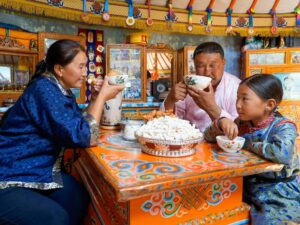
Nomadic family inside of their ger. Photo: Shutterstock
The Numbers
Mid-range ger camps near historical centers like Karakorum run approximately $50–$115 USD per night including meals, depending on whether you choose a standard ger with shared facilities or a deluxe ensuite option. Luxury camps in more remote regions sit at a higher tier commensurate with their location and level of finish. Most camps are accessible from Ulaanbaatar, served by direct flights from Seoul, Beijing, Moscow, and Frankfurt. The drive from Ulaanbaatar to Karakorum runs approximately six hours on paved road. Khövsgöl is accessible via domestic flight to Mörön, followed by a short transfer. Mongolia requires a visa for most nationalities — check entry requirements well in advance, as processing times vary by country.