
Pakistan Travel Guide for First-Time Visitors
It has mountains, desert, beaches, ancient history, and one of the best food scenes in the world. The only thing holding most travelers back is a misconception.
By Amina Mamaty | Published on May 27, 2026
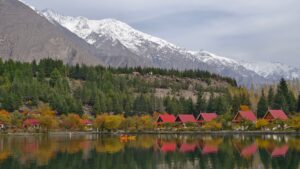
Skardu lake in Northern Pakistan. Photo: Shutterstock
Pakistan is not what most people imagine. That gap between expectation and reality is wider here than almost anywhere else on earth. The country has mountains that rival anywhere in Asia, a coastline most of the world doesn’t know exists, ancient history that predates most civilizations, and cities that move at a speed that takes days to adjust to. It also has some of the most generous hospitality of any destination on the planet. None of that makes it into the conversation because the conversation rarely gets past the headlines.
First-timers who go with an open mind tend to leave with the same response: it was ten times better than anything they could have imagined.
Stop Comparing It to Its Neighbors
Pakistan shares a border with Afghanistan and the two countries are frequently conflated in Western media. They are not the same. Afghanistan operates under significantly more conservative social restrictions. Pakistan is a country where women hold positions of power across government, business, and culture — where cities are modern, fashion-forward, and cosmopolitan in ways that catch most visitors completely off guard. Karachi alone has a population of over twenty million people. It has beach clubs, rooftop restaurants, shopping malls, and a food scene that rivals any major city in Asia. The association with neighboring countries has cost Pakistan decades of tourism it deserved. Go and see it for yourself.
Getting There and Visas
Pakistan’s main international entry points are Jinnah International Airport in Karachi, Allama Iqbal International Airport in Lahore, and Islamabad International Airport. Most Western passport holders can obtain a visa online — the process typically takes around 48 hours and is straightforward. No embassy visit required.
The Cities
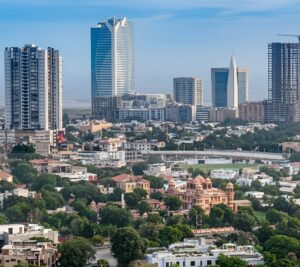
Karachi skyline. Photo: Shutterstock.
Pakistan’s three main cities each have a completely distinct character.
Karachi is the country’s largest city and its economic engine. It moves fast, it is loud, and it does not slow down. Think New York — the chaos, the ambition, the energy of a megacity that never fully sleeps. It is also the most diverse city in Pakistan, with communities, cuisines, and neighborhoods that reflect the full breadth of the country. The Mausoleum of Muhammad Ali Jinnah — the founder of Pakistan — as well as his former residence, The Quaid-e-Azam House Museum, are one of the most significant sites in the country and worth visiting to understand what the nation was built on. Dolmen Mall gives a different but equally valid picture: modern, busy, full of Pakistani brands and international names side by side. Both are Karachi.
Islamabad is the capital and feels like it. Clean, organized, green, and considerably calmer than Karachi — think Washington D.C. It is a city built with intention and it shows. The pace is slower, the infrastructure is better, and it serves as the natural gateway to northern Pakistan.
Lahore is where Pakistan’s history lives. The food scene is arguably the best in the country, the Mughal architecture is extraordinary, and the old city moves at a pace that makes exploration on foot genuinely possible. It deserves more time than most first-timers give it.
The North
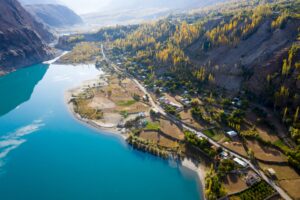
Hunza Valley in Northern Pakistan. Photo: Shutterstock
Northern Pakistan — Hunza, Skardu, Gilgit-Baltistan — is one of the most visually spectacular regions in Asia. The mountains are enormous, the valleys change color dramatically in autumn, and the sense of remoteness is real in a way that few places still offer. September is the best month to visit: the weather is clear, the fall colors are at their peak, and the roads are open. Do not go in November, December, or January. It is off-season, temperatures drop severely, and most hotels close until April. The region is worth planning carefully around.
Getting around the north requires a private car. There are no ride apps operating in Gilgit-Baltistan. Arrange ground transportation through your accommodation in advance.
The Coast
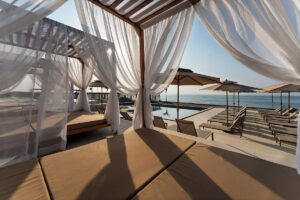
View from Khoj Resorts Allana in Karachi. Photo: Khoj Resorts Allana
Most people do not know Pakistan has a coastline. It does — stretching along the Arabian Sea from Karachi westward — and the experience of it is unlike anything most visitors expect. The beach clubs along the Karachi coast are social, lively, and centered around fresh seafood. Visitors can fish directly off the coast and have their catch cooked on the spot. There is hookah, there are sunset views, and there is no shortage of grilled fish and prawns at prices that make the experience feel almost unreasonably good. It is not a bikini beach. Dress modestly and follow the lead of those around you.
The Food
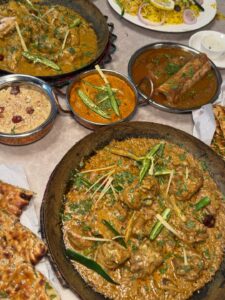
Pakistani food spread. Photo: Spice of Lahore
Pakistani food is one of the strongest arguments for going. Karachi biryani is its own category — spicier and more complex than versions found elsewhere, and available everywhere from street stalls to sit-down restaurants. Paratha — a layered flatbread served at breakfast — eaten with honey, meat, or whatever is available, is the kind of simple thing that becomes a daily ritual within days of arriving. BBQ Tonight is a Karachi institution: a chain that has been feeding the city for decades and remains one of the best introductions to Pakistani grilling available anywhere.
Lahore’s food scene goes deeper into Mughal-influenced cooking — richer, more layered, worth dedicating meals specifically to exploring. Eat everywhere: restaurants, street stalls, and if the opportunity to eat in someone’s home presents itself, take it without hesitation.
The Sheedi Community
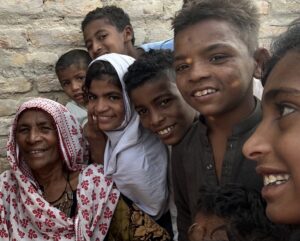
Sheedi community in Badin, Pakistan. Photo: Young International
One of Pakistan’s least-known stories is the presence of the Sheedi people — Pakistanis of African descent, concentrated primarily in Karachi and parts of Sindh, whose ancestors arrived centuries ago through trade routes and migration across the Arabian Sea. They have maintained distinct cultural traditions including music and dance. Most visitors, but also locals, have never heard of them. Their existence is a reminder that Pakistan’s diversity runs deeper than most of the world’s coverage of the country has ever bothered to explore.
What to Wear
Pakistan is a Muslim-majority country and dress code matters, particularly outside major city centers. For women: cover shoulders, avoid low necklines, and keep thighs covered. Loose, modest clothing is the standard — it is also more comfortable in the heat. In Karachi and Islamabad, modern dress is common among locals, but erring toward modesty is always the right call for visitors. Public displays of affection are not appropriate anywhere in the country.
Getting Around
In Karachi, Lahore, and Islamabad, Uber and Bolt both operate and work well. Use them. In northern Pakistan and when visiting areas outside major city centers, a private car with a driver arranged through your accommodation is the only practical option. Having a local contact or guide changes the experience significantly — not because Pakistan is difficult to navigate alone, but because doors open differently with someone who knows the place.
Common sense applies as it does in any major city: avoid unfamiliar areas late at night, stay aware of your surroundings, and follow local advice on specific neighborhoods. Crime exists in Pakistan as it does everywhere. What does not exist — for the vast majority of visitors who go — is the danger that the country’s international reputation implies.
Getting There
Pakistan International Airlines, Qatar Airways, Emirates, Turkish Airlines, and Etihad all serve Pakistan’s major airports with connections through Doha, Dubai, Istanbul, and Abu Dhabi. From the United States and Europe, expect one connection. Visa applications are processed online and typically approved within 48 hours.
The Numbers
Pakistan’s currency is the Pakistani Rupee (PKR). Cash is essential throughout the country — cards are accepted at hotels and larger restaurants in major cities but cannot be relied upon everywhere. Budget accommodation in Karachi and Lahore starts around 5,000–8,000 PKR (18–29 USD) per night; mid-range hotels run 15,000–35,000 PKR (54–125 USD). In the north, guesthouses in Hunza start around 8,000–15,000 PKR (29–54 USD) and most operate April through October only. A full meal at a local restaurant runs 800–2,000 PKR (3–7 USD). The best time to visit is May through December — May through August is extremely hot in the plains, making September the optimal month for northern Pakistan and October through December ideal for Karachi and Lahore.