
Karachi Uncovered: Pakistan’s Megacity That Never Sleeps
There is a particular kind of energy that certain cities carry — a restlessness that never fully powers down, a pulse that keeps beating long after midnight. New York has it. Lagos has it. Karachi has it too — a coastal megacity of over 20 million people where the streets stay loud and the city keeps moving long after dark.
By Amina Mamaty | Published on May 26, 2026
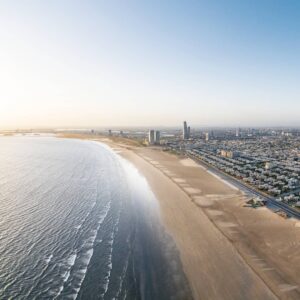
Karachi at golden hour. Photo: Shutterstock
With an estimated population pushing 20 million, Karachi is one of the most densely populated cities on earth. It is Pakistan’s economic engine, its cultural crossroads, its loudest argument for why this country deserves far more attention than it gets. Glass skyscrapers rise alongside crumbling colonial facades. Designer malls sit minutes from markets where vendors have been selling the same goods for generations. Traffic laws appear to be, at best, a suggestion. The city does not pause for you to catch your breath — and that is precisely the point.
The City Jinnah Built
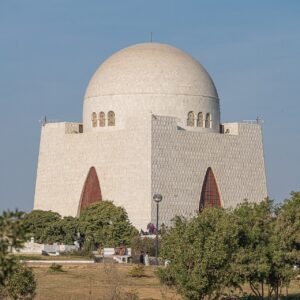
The Jinnah Mausoleum. Photo: Young International
To understand Karachi is to first understand Mohammad Ali Jinnah. The founder of Pakistan was born here, practiced law here, and is buried here — and the city has never let him go. His mausoleum, a gleaming white marble structure set on a raised platform in the heart of the city, is one of the most quietly powerful places in South Asia. Inside, the scale of it settles on you differently than expected. The space is vast and cool and reverential, ringed by an honor guard and filled with the kind of silence that feels earned. Outside, Karachi roars on. The contrast is not lost on anyone who makes the visit.
Jinnah’s presence is woven into the fabric of daily life here — in street names, in portraits, in the particular civic pride that Karachiites carry. This was, after all, the first capital of Pakistan. The city knows its own weight.
The Roads, the Chaos, the Rhythm
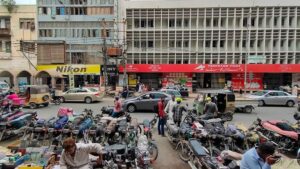
Karachi traffic. Photo: Young International
No one warns you adequately about the roads. Karachi’s traffic is not just busy — it is a full sensory experience, a negotiation happening in real time between motorcycles, rickshaws, painted buses, and cars that communicate almost entirely through their horns. The scale of the city means that even short distances take time, and the journey itself becomes part of the experience.
Shah Faisal, one of the city’s sprawling residential and commercial neighborhoods, offers a ground-level view of how Karachi actually lives — not the version polished for visitors, but the everyday version, the one that moves fast and smells like street food and diesel and something frying nearby. The roads here are wide and relentless, and the city unfolds around you in layers the longer you stay in it.
Zainab Market: Prepare to Get Lost
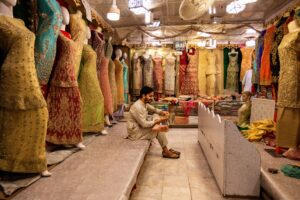
Inside Zainab Market. Photo: Shutterstock
There is really only one way to do Zainab Market, and that is to surrender to it. Karachi’s most famous shopping district is a labyrinth of stalls selling everything from fabric and clothing to electronics, jewelry, street food, and goods that defy easy categorization. The vendors are persistent. The alleyways multiply. The noise is constant and layered and somehow joyful.
Getting lost here is not a failure of navigation — it is the whole experience. Every wrong turn reveals something worth stopping for: a stall selling hand-embroidered textiles, a cart piled with fresh-cut fruit, a tailor working at speed with fabric that costs a fraction of what it would anywhere else. Budget more time than seems reasonable, keep small bills accessible, and let the market do what it does.
A Different World, Just Down the Road
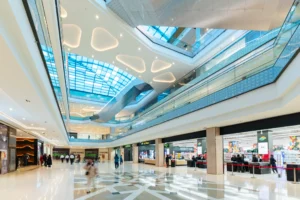
Dolmen Mall. Photo: Dolmen Mall Shopping Center
The malls of Karachi tend to surprise first-time visitors, and that surprise is worth sitting with. Dolmen Mall and Ocean Mall are not afterthoughts — they are full-scale, contemporary retail destinations with international brands, food courts, cinema complexes, and an air-conditioned remove from the city outside that feels almost cinematic in its contrast. Within the space of twenty minutes, a visitor can move from the organized chaos of Zainab Market to an environment that would look at home in Dubai or Singapore.
This is Karachi’s central tension and its greatest fascination: the city contains multitudes, and it makes no apologies for any of them.
The Food
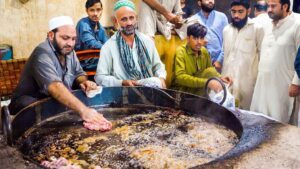
Street food in Karachi. Photo: Shutterstock
Karachi’s food culture is its own argument for the visit. The city’s biryani — specifically Karachi-style, with its longer-grain rice, its depth of spice, its particular fragrance — is the subject of genuine civic pride and ongoing debate about whose version is best. Street food stalls operating from carts and narrow shopfronts serve nihari, chaat, and seekh kebabs at hours that make no concession to conventional mealtimes. The rule in Karachi is simple: eat where it’s busy, eat where locals are standing, and don’t overthink it.
What Karachi Asks of You
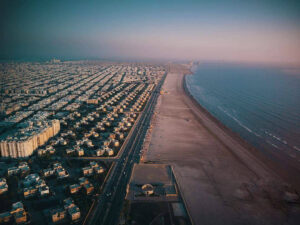
Clifton Beach in Karachi. Photo: Shutterstock
Karachi is not a city that reveals itself on the surface. It asks for time, for patience, for a willingness to move through it without a fixed agenda. The chaos is real — the traffic, the noise, the sheer human density of the place — but underneath it is a city with genuine warmth, with history that runs deep, with a population that takes pride in a place the rest of the world has largely underestimated.
Come with comfortable shoes, a flexible itinerary, and a full afternoon earmarked for Zainab Market. Leave with the particular satisfaction of a city that gave you more than you came looking for.
The Numbers
Karachi sits on Pakistan’s Arabian Sea coast in Sindh province, covering roughly 3,500 square kilometers and home to an estimated 15 to 20 million people depending on how city boundaries are drawn — making it one of the ten largest cities on earth. The currency is the Pakistani rupee (PKR); as of publication, approximately 280 PKR to the US dollar, though rates fluctuate. The city operates on Pakistan Standard Time (UTC+5). The best time to visit is between November and February, when temperatures settle into the low-to-mid 20s Celsius (70s Fahrenheit) and the humidity eases. Summers are intense — June through August brings heat that peaks above 40°C (104°F), compounded by humidity from the coast. Visas are required for most nationalities and should be arranged well in advance; Pakistan’s e-visa system has simplified the process considerably. English is widely spoken in hotels, malls, and among educated Karachiites, though a few words of Urdu will be received warmly. Karachi’s Jinnah International Airport connects to major hubs including Dubai, Doha, Istanbul, and London.