
Kosovo Explained: Europe’s Youngest Country and What That Means for Travelers
A country born in 2008, shaped by centuries, and only now beginning to appear on the world’s travel map.
By Adebola MBV | Published on June 2, 2026
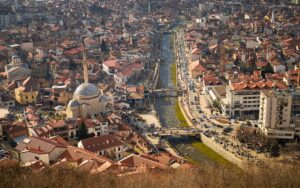
Aerial view of Prizren. Photo: Shutterstock
On the 17th of February 2008, Kosovo declared independence from Serbia. It became, at that moment, the newest country in Europe. Sixteen years later, it still is.
Understanding Kosovo is not required to enjoy it. But it makes the visit significantly richer.
Europe’s Youngest Country: The Basics
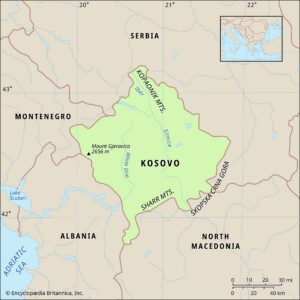
Map of the Western Balkans. Photo: Shutterstock
Kosovo sits in the heart of the Western Balkans, landlocked and surrounded by Serbia to the north and east, North Macedonia to the south, Albania to the west, and Montenegro to the northwest. It covers roughly 10,887 square kilometres, smaller than the state of Connecticut, and has a population of approximately 1.8 million people.
Its capital is Pristina. Its cultural hub is Prizren. Its gateway to nature is Peja. These three cities form the core of any meaningful visit to the country.
Independence, Recognition, and the Flags You Will See Everywhere
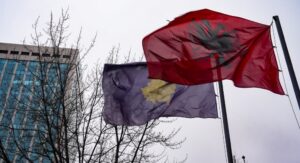
Albanian and Kosovo flags side by side. Photo: Shutterstock
Kosovo’s declaration of independence from Serbia in 2008 was recognized by the United States, the United Kingdom, France, Germany, and most NATO and EU member states. Russia, China, Serbia, Spain, and several others do not recognize it. As of now, over 100 of 193 UN member states have extended formal recognition.
In Prizren, there is a building that displays the flags of every nation that has recognized Kosovo. It is a public and deliberate statement, a piece of living political architecture that tells you exactly where the country stands and who stands with it.
Throughout Kosovo, Albanian flags fly alongside the official Kosovo flag. This is not incidental. Kosovo’s population is over 90 percent ethnically Albanian. The Albanian flag, with its black double-headed eagle on a red field, carries centuries of history as a symbol of Albanian identity and resistance, most notably associated with the 15th-century national hero Skanderbeg. For Kosovo Albanians, flying that flag is an expression of cultural identity, not a rejection of Kosovar statehood, but an affirmation of who they are within it.
Ask a local, particularly a taxi driver in Pristina, and the explanation will come with real feeling. Many Kosovans see themselves as Albanian first, Kosovar second, or hold both identities simultaneously without contradiction. It is one of the most interesting conversations a visitor can have.
The History Behind the Headlines
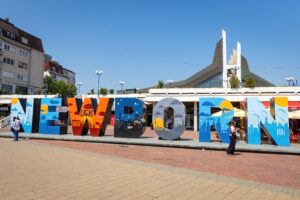
Newborn Monument in Pristina. Photo: Shutterstock
Kosovo’s path to independence ran through decades of tension within Yugoslavia, a 1998 to 1999 war between Yugoslav security forces and the Kosovo Liberation Army, NATO intervention, and nearly a decade of UN administration before the 2008 declaration. The International Court of Justice ruled in 2010 that Kosovo’s declaration of independence did not violate international law. Serbia rejected that decision and continues to regard Kosovo as part of its own territory.
What this means on the ground for travelers is not danger or unease. Kosovo is safe, and the atmosphere in both Pristina and Prizren is warm and relaxed. What it does mean is that the country’s recent past is not distant, it is present in the conversations, the architecture, the flags, and the particular way Kosovo carries its own sense of identity.
Travelers who come with some awareness of that context tend to experience the country very differently from those who don’t. The walls, the monuments, and the people will offer more to anyone who arrives ready to understand what they’re looking at.
What the Youngest Country in Europe Actually Feels Like
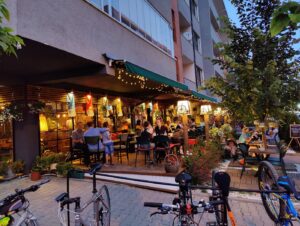
Café terrace in Pristina. Photo: Shutterstock
Pristina is not what most people expect. It is a city of street murals, creative spaces, packed café terraces, and a population that skews young and outward-looking. The Newborn Monument, a large sculptural installation that has changed its design every year since 2008 to reflect Kosovo’s ongoing development, is the most photographed symbol of the city’s spirit. Mother Teresa Boulevard, the main pedestrian thoroughfare, is lined with bookshops, local vendors, and locals of every age.
Prizren: Where the History Lives
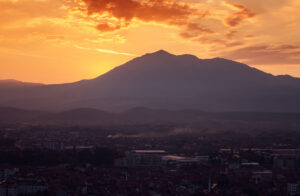
Prizren at golden hour. Photo: Shutterstock
Prizren was Kosovo’s capital in an earlier era, and it still carries that authority. The old town is compact and walkable, built around an Ottoman stone bridge and a mosque, with the Kalaja fortress sitting on the hill above. At night, the old town fills with people, locals and visitors sharing the same cobblestoned streets and the same restaurants.
A day trip from Pristina to Prizren costs around €5 ($8)by bus and takes roughly two hours. It is among the best-value travel days available anywhere in Europe.
Why This Matters for Travelers
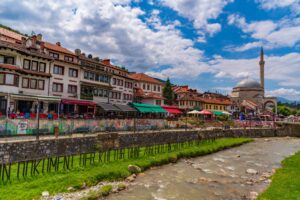
Prizren riverfront. Photo: Shutterstock
Kosovo is still a relatively new country with a rich, complex history that most people outside the Balkans do not fully understand. It has not been over-commercialized. The food is the real food people actually eat. The welcome is the welcome Kosovars actually extend to strangers, open and warm.
For travelers who have covered 60, 70, or more countries and are searching for somewhere that still feels authentic and unperformed, Kosovo delivers that in a way that is increasingly difficult to find in Europe.
There is also something specific about visiting a country that has lived through its own humanitarian crisis within the past three decades. For travelers from communities that carry their own histories of displacement, conflict, and rebuilding, Kosovo offers a particular kind of connection. A recognition, across different histories, of what resilience and community look like when a people decide to keep going.
That is not a small thing to find in a destination. Kosovo has it.
The Numbers
Kosovo uses the euro. Foreign visitors have grown by 12 percent in the first eight months of 2024 compared to the previous year, and by 41 percent compared to 2022 — a sign that the word is beginning to spread. A mid-range visit runs approximately €45 to €55 (around $50 to $60 USD) per person per day. Pristina to Prizren by bus costs around €5 (approximately $5.50 USD) each way. The country is visa-free for British and American passport holders for stays up to 90 days; Nigerian and Chinese passport holders require a visa arranged in advance.
The Bottom Line
Kosovo declared independence in 2008. It is Europe’s youngest country. It is also, for the traveler willing to look past the unfamiliar name.