
What First-Time Travelers Should Know Before Visiting Georgia
These Georgia travel tips will help first-time visitors navigate the country, understand local customs, and make the most of their trip.
By Malikah Kelly | Published on June 1, 2026

Tbilisi Old Town. Photo: Shutterstock
Georgia Travel Tips for First-Time Visitors
The trip started with a one-way flight from Beirut. No grand plan, no checklist of landmarks, just a route that appeared while browsing flights and felt worth booking on a whim. Georgia was not the obvious choice. It was the interesting one.
Traveling solo, and aware that this was not a destination where American or Black travelers show up in large numbers, there was a natural wariness going in. It dissolved almost immediately. Wandering the streets of Old Town felt comfortable from the first hour, the kind of ease that is hard to manufacture and impossible to fake.
Getting There and Getting Around

YIM Contributor, Malikah Kelly, in old town Tbilisi. Photo: Malikah Kelly
Getting around Tbilisi is easy and affordable. The city has a reliable public transport system covering most major areas, including buses, trams, and a metro. For many of the popular sites, walking is the better option — distances are short, the streets are manageable, and the city reveals more of itself on foot than from the back of a car.
When a taxi is needed, Bolt is the app to download before arriving. Uber was not available at the time of this visit, but Bolt works the same way and runs very affordably throughout the city.
One thing worth knowing in advance: grocery shopping is a genuine challenge. Signs and product labels are almost entirely in Georgian script, which gives nothing away. Most younger Georgians speak some English and are happy to help, but the supermarket is one place the language barrier makes itself known. Markets and restaurants are a much easier place to start.
Money
Georgia is not on the Euro despite its European identity. The official currency is the Georgian Lari (GEL). Most restaurants and shops accept cards, but cash is worth having for market shopping and tipping guides. Skip the airport currency exchange — an ATM withdrawal at a local bank is the better move.
Safety and How to Actually Enjoy the City
As a Black female solo traveler, Tbilisi felt safe to navigate. The approach that worked best was filling the itinerary with guided tours — not out of fear, but as a practical decision to ensure the trip was genuinely enjoyable without having to manage logistics and safety questions simultaneously.
The first day included a travel photo shoot that turned into something more useful: half incredible photos, half a guided history walk through the city. It gave real time to absorb the beauty of Tbilisi and plenty of opportunity to talk with a local. For first-time visitors especially, starting the trip this way — a guided experience that doubles as orientation — is one of the smartest moves available.
Beyond Tbilisi
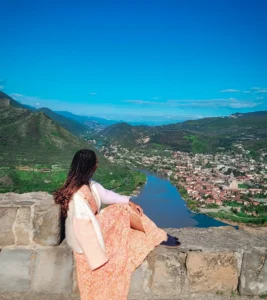
YIM Contributor, Malikah Kelly, at Jvari Monastery. Photo: Malikah Kelly
Tbilisi gets most of the attention, but the country beyond the capital is where Georgia’s scale becomes clear. One of the standout experiences was a full-day tour east of the city, stopping at the Jvari Monastery, the Russian-Georgian Friendship Monument, and the Gergeti Trinity Church. It covered an extraordinary amount of landscape and history without requiring anyone to organize their own transport, a full day of culture and scenery that is one of the most effective ways to understand the country’s depth beyond the city.
One practical note: the weather shifts dramatically the further from Tbilisi you go. The capital in late April may feel mild, but the mountains can still have snow. Pack a warm layer regardless of when the trip falls.
The Food and Wine

Georgian food spread. Photo: Shutterstock
Georgian cuisine is built around bold, hearty dishes shaped by centuries of cultural exchange. Khinkali — the doughy dumplings filled with spiced meat and broth, eaten by hand with a specific technique locals will demonstrate — are essential. Khachapuri, the cheese-filled bread that comes in several regional variations, is on every table. Chakhokhbili, a slow-cooked chicken stew with tomatoes and herbs, is a reliable introduction to how Georgian cooking actually works.
The food takes some getting used to if the flavors are unfamiliar, but it is always worth trying — Georgian cuisine truly tells the story of the country. For the wine, there is no hesitation: Georgia has one of the oldest winemaking traditions on earth, and even a short tasting session in Old Town is enough to understand what the global conversation is about. If the schedule allows, a wine tour is worth prioritizing over almost anything else on the list.
The History You Will See Everywhere
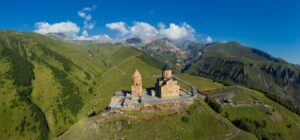
Gergeti Trinity Church. Photo: Shutterstock
Georgia’s history is a complex one, and its location puts it front and center of several modern geopolitical tensions. As a tourist those tensions do not press down on daily life, but if the conversations go there — and with the right local guide, they will , the insights into how the fusion of cultures and geopolitical landscape shapes everyday life are genuinely fascinating.
The visual influences are stunning. Ottoman-style bathhouses, Persian-influenced food, Soviet-era brutalist architecture scattered throughout the city, Tbilisi is a photography dream precisely because it does not resolve into a single aesthetic. The Soviet influence on the economy still runs deep, and while younger Georgians speak English from school, most of the older generation speak Russian. That layering is visible everywhere, once you know to look for it.
One Thing Worth Knowing

Tbilisi from above. Photo: Shutterstock
Georgia is the perfect destination to combine with another country. Armenia is a natural add-on — reachable for a day trip or overnight from Tbilisi without much planning, and a completely different kind of experience that makes the overall trip feel larger.
And one final note, from experience: skip the bathhouses. Georgia is famous for its sulfur baths, and the curiosity is understandable. But spend a session in one and the smell of rotten eggs will follow for the rest of the day. Some things are better left as a story than an experience.
The Numbers
Georgia uses the Georgian Lari (GEL). At the time of publication, 1 GEL is approximately $0.37 USD. A comfortable mid-range trip runs roughly 150 to 200 GEL (around $55 to $75 USD) per person per day covering accommodation, local meals, and transport. Bolt rides within Tbilisi typically cost between 5 and 15 GEL ($2 to $6 USD). Guided day tours outside the city range from 80 to 150 GEL ($30 to $55 USD) depending on length and itinerary. Most major restaurants and hotels accept cards; cash is recommended for markets and guides.
The combination of ancient history, food and wine culture, beach cities like Batumi on the Black Sea, and mountain landscapes in every direction makes Georgia one of the most complete travel destinations in the region. Go now, before everyone else catches on.