
The Cholitas of La Paz: Bolivia’s Most Iconic Women and What They Represent
The cholitas of La Paz have become symbols of resilience, cultural pride, and indigenous identity in modern Bolivia. They were banned from public squares, refused entry to restaurants, and told their clothing was shameful. Today, cholitas run businesses, sit in parliament, walk runways, and throw people across wrestling rings.
By Amina Mamaty | Published on June 3, 2026
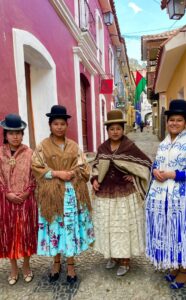
Cholitas on Calle Jaen in La Paz. Photo: Young International
The word cholita started as an insult. It is a diminutive form of the word “chola,” originally a pejorative term referring to those of indigenous heritage. For most of the 20th century it was used to diminish, to mark indigenous Aymara and Quechua women as lesser, as rural, as out of place in the cities they had migrated to and built their lives in. Cholitas faced severe discrimination. They were banned from certain public spaces, denied entry into restaurants, and prohibited from wearing their traditional clothing in government buildings.
That has changed. Today, being a cholita is a symbol of pride, strength, and cultural identity. Cholitas walk confidently through the streets of La Paz and El Alto. They manage businesses, lead social movements, and step into the wrestling ring. The transformation did not happen quietly. It happened through decades of resistance, through political change, and through a group of women who decided to make their identity impossible to ignore.
The Cholitas of La Paz: Traditional Dress and Meaning
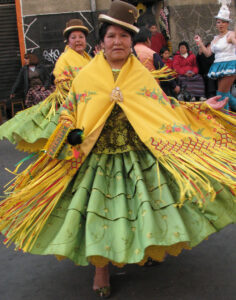
Cholita traditional attire: the pollera skirt, bowler hat, shawl and braids. Photo: Shutterstock
The traditional cholita dress consists of layers of skirts called polleras, a bowler hat, a fringed shawl, jewelry, and braided hair. Each element carries specific meaning. How the bowler hat is placed on the head can signify the marital status of the wearer: straight means married, tilted means single. The fuller the pollera skirt, the better, as it makes the hips look curvier, which signifies health and fertility.
The irony embedded in the cholita’s dress is significant. The pollera started out as a colonial imposition, with Spanish rulers forcing indigenous women to dress in a more European fashion. But cholitas took that imposition and made it their own, turning the pollera into something beautiful and deeply symbolic, a proud emblem of their culture. The bowler hat has a similar origin: after trying unsuccessfully to persuade Bolivian men to wear bowlers, hat importers turned their attention to indigenous women and found massive success. What was forced became claimed. What was imposed became identity. That conversion is the central fact of what cholitas represent.
Unlike many types of traditional dress, the cholita’s costume is not for tourist show. The women wearing it on the streets of La Paz are not performing for visitors. They are dressing as they have always dressed, in a tradition that now carries the additional weight of everything it took to keep it.
The Political Turn
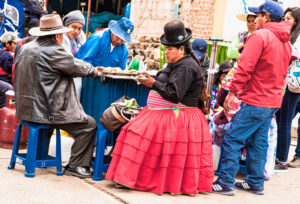
Cholita. Photo: Shutterstock
After decades of struggling to protect their culture and identity, indigenous communities scored a significant win in 2005, when Bolivia elected Evo Morales as its first indigenous president. New and groundbreaking policies promoted indigenous involvement across all sectors of society, leading cholitas to step into public life in ways that were previously unimaginable.
They emerged as key players in government, pursued higher education in greater numbers, and became prominent in various industries from banking to television. Wearing their traditional polleras in government offices, once strictly prohibited, became a bold symbol of this transformation.
Today, cholitas can be found working as journalists, politicians, and television anchors. La Paz now even has a cholita-focused modeling agency that stages runway fashion shows. Bolivia also holds an annual Cholita Fashion Show, where women present elaborate polleras, each one a display of intricate embroidery, precise pleats, and layered fabric. The same clothing that was once used to exclude these women from public life is now the centerpiece of national cultural celebration.
Cholita Wrestling in La Paz
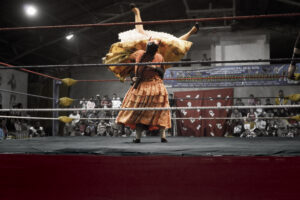
Cholitas wrestling in the ring. Photo: Shutterstock
Cholita wrestling got its start in the early 2000s in Bolivia, when a promoter of men’s wrestling introduced women wrestlers to revive declining interest in the sport. The women first performed in traditional wrestling attire, but the crowds were not impressed. When they entered the ring in their pollera skirts and with long braids, interest grew tenfold.
What began as a commercial decision became something considerably larger. In the early 2000s, many indigenous women in El Alto and La Paz were facing systemic discrimination, poverty, and domestic abuse. Some women began learning martial arts-style moves as a way to protect themselves, supported by community organizations. Over time, they started teaching other women.
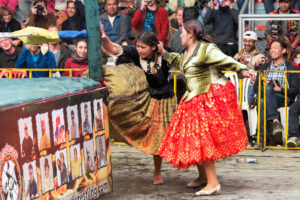
Cholitas wrestling. Photo: Shutterstock
Matches typically begin with a male villain attacking a female victim, a theatrical representation that, despite being completely staged, reflects the reality of domestic violence in Bolivia, where femicides were recorded at an alarming rate. The cholita eventually finds the strength to fight back. Against this backdrop, many locals consider cholita wrestling an act of empowerment.
For the women in the ring, wrestling is more than entertainment. “We want to show the world that cholitas can do anything,” said Yolanda “La Amorosa” Cortez, one of the most well-known cholita wrestlers performing today. They were not wrestling for the money, which pays between $12 and $15 per match. It had become their passion to showcase their athletic abilities while earning respect and admiration for who they are.
What Cholitas Represent Beyond Bolivia
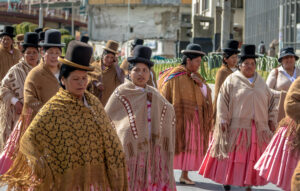
Cholitas. Photo: Shutterstock
The cholita has become the most internationally recognizable symbol of Bolivia, and that recognition carries a specific weight. These are not women who have been packaged for tourism. They are women whose visibility is the direct result of a political and cultural fight that took decades and is still ongoing.
The image of a cholita in full pollera, bowler hat perfectly placed, conducting her business in a La Paz market or throwing an opponent across a wrestling ring is not an accident. It is the product of a community that decided its culture was worth fighting for and then demonstrated exactly what fighting for it looks like.
For travelers in La Paz, cholitas are everywhere: in the markets, on the cable cars, in government offices, at cultural events. Engaging respectfully, asking before photographing, and understanding what the dress represents rather than treating it as a photo opportunity produces a very different kind of encounter. Bolivia’s most iconic women are not there to be observed. They are there because this is their city.
How to See Cholita Wrestling
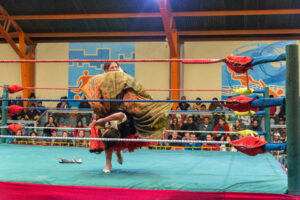
Cholitas at wrestling venue in El Alto. Photo: Shutterstock
Most La Paz tour agencies sell packages that include transport, admission, an English-speaking guide, and snacks for approximately 80 to 90 Bolivianos, around $12 USD. The Sunday show is the better attended of the two and draws a strong local crowd alongside tourists.
If seated in the front rows, anticipate involvement. Drinks and popcorn are part of the show, and the wrestlers regularly interact with the audience. Asking cholita wrestlers for a photo after the match is standard practice; a small tip of around 5 Bolivianos is the appropriate acknowledgment. The show runs approximately two hours and is theatrical, comedic, athletic, and politically loaded all at the same time. Understanding the history before arriving makes the experience significantly more than entertainment.
The cholitas of La Paz are not a tourist attraction. They are the most visible expression of an indigenous culture that refused to disappear, then refused to stay quiet, then refused to stay out of the ring. Visiting Bolivia without understanding what they represent is visiting Bolivia without understanding Bolivia.
The Numbers
Cholita wrestling packages sold through La Paz tour agencies cost approximately 80 to 90 Bolivianos, around $12 USD, and typically include transport, admission, a guide, and snacks. A tip of around 5 Bolivianos ($0.70 USD) is standard after photos with wrestlers. Matches run on Thursdays and Sundays in El Alto, with Sunday drawing the stronger local crowd. The Cholita Fashion Show takes place annually in La Paz. Entry to most cultural markets in the city is free. A comfortable mid-range day in La Paz runs approximately 300 to 400 Bolivianos, around $44 to $58 USD, covering accommodation, meals, and local transport.