
Why Nigerians Tell You Not to Visit Nigeria Solo (And Why You Should Go Anyway)
The warnings are loud, the opinions are strong, and most of them come from people who have never actually been.
By Amina Mamaty l Published on April 27, 2026
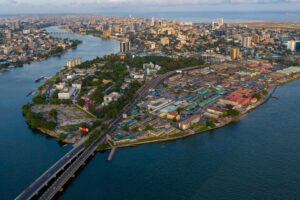
Victoria Island – Lagos, Nigeria. Photo: Shutterstock
There is a particular kind of authority that Nigerians in the diaspora hold when it comes to the subject of home. It is worn like a birthright — an inherited intimacy with a place that, for many, exists more in memory and family mythology than in lived experience. Ask a Nigerian-American whether someone should travel solo to Lagos, and the answer arrives fast, certain, and almost always the same: don’t.
The problem is that much of what the diaspora believes about solo travel in Nigeria is wrong. Not maliciously so, but wrong in the way that secondhand knowledge almost always is — shaped by fear, frozen in time, and passed down with the full confidence of fact.
This is not an argument that Nigeria is without complexity. It is an argument that complexity is not the same as inaccessibility, and that the loudest voices discouraging solo travel to the country are often the least qualified to make that call.
The Warning That Gets Inherited
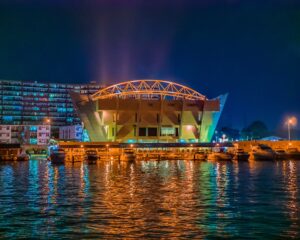
The Civic Centre Ozumba Mbadiwe Avenue in Victoria Island – Lagos, Nigeria. Photo: Shutterstock
For many in the Nigerian diaspora, the relationship with home is mediated through parents who left during periods of genuine instability — military rule, economic collapse, the volatility of the late eighties and nineties. Those parents carried real stories of real difficulty. They passed those stories to their children, often as warnings, sometimes as identity, always as truth. What they could not pass down was the update.
Nigeria in 2025 is not Nigeria in 1995. Lagos today bears little resemblance to the city that exists in the collective diaspora imagination. The skyline of Victoria Island has transformed. Abuja — purpose-built, orderly, remarkably green — functions as one of the most navigable capitals on the continent. Lekki has produced an entire generation of boutique hotels, rooftop bars, and creative spaces that rival anything in Accra or Nairobi. Ride-hailing apps work seamlessly across both cities. The infrastructure gap that made independent travel genuinely difficult a generation ago has narrowed considerably, and in certain pockets, it has closed almost entirely.
None of this filters through in diaspora travel discourse, because diaspora travel discourse is largely not being generated by people who have actually gone.
The Safety Narrative That Doesn’t Hold

Photo: Shutterstock
There is a version of Nigeria travel advice that is careful, thorough, and ultimately self-defeating. It acknowledges that Lagos, Abuja, and Calabar have well-established infrastructure and are considerably safer than northeastern regions where tourism is genuinely not advisable. It notes that Nigerians are — and here the language almost always stumbles into warmth it didn’t budget for — exceptionally hospitable and protective of visitors. It concedes that many solo travelers, including women traveling alone, return with accounts of extraordinary human connection and cultural richness impossible to find elsewhere.
And then, after all of that, it concludes that Nigeria may not be suitable for first-time solo travelers.
The whiplash is the point. This is what well-intentioned caution looks like when it has absorbed too much diaspora energy and not enough firsthand experience — a destination talked out of its own potential by the people most emotionally invested in it.
Solo travel in Nigeria requires preparation, the same kind any thoughtful traveler brings to Mexico City, Nairobi, or Bogotá. Yellow fever vaccination is mandatory at entry. A local SIM card is essential. Ride-hailing replaces street taxis. Neighborhoods matter, and knowing the difference between Victoria Island and areas further inland is basic research, not specialized knowledge. The precautions are real and reasonable. They are also identical to the precautions issued for dozens of cities that the same diaspora voices will book flights to without blinking.
The selective application of that caution — reserved almost entirely for African destinations, and Nigeria in particular — says less about actual risk and more about the framework through which the country is being filtered.
One fair caveat: if Nigeria would be your first time traveling solo anywhere outside of Europe or North America, the learning curve is real — but it has nothing to do with Nigeria specifically. It has everything to do with solo travel itself. Build that muscle first, then come.
What Lagos and Abuja Actually Offer

Shiro Lagos Restaurant. Photo: Shiro Lagos
Lagos is not a destination for the passive traveler. It demands engagement — with its noise, its pace, its refusal to be contained by anyone’s expectations of what an African city should look like. The art scene anchored around Lagos Island has become one of the most significant on the continent. The restaurant culture on Victoria Island and in Lekki is serious in the way that only cities with a genuine food obsession manage to produce. The music didn’t go global by accident. It grew from something still very much present and alive on the ground, and being in the city where it lives is not a small thing.
What no travel warning prepares you for is the energy. Nigerians are among the most self-possessed people on earth — confident, unhurried on their own terms, and wholly uninterested in performing for the tourist gaze. Service moves at its own pace. Plans shift. The city is not optimized for your comfort, and it does not apologize for that. This is not hostility. It is the particular freedom of a culture that is profoundly unbothered — one that will welcome you warmly and also make clear, without saying a word, that it was doing just fine before you arrived and will continue to do so after you leave. Once you understand that dynamic, it stops feeling like a challenge and starts feeling like the most honest travel experience you’ve ever had.
Abuja operates differently — quieter, considered, with the wide boulevards and organized districts of a planned capital. For solo travelers who want a softer entry point into Nigeria, it is exactly that. The city sits at the foot of Zuma Rock, one of the most arresting natural landmarks in West Africa, and offers a pace that allows for real orientation before the full sensory immersion of Lagos.
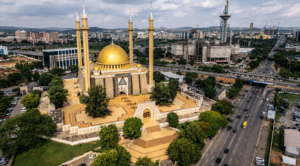
Abuja National Mosque. Photo: Shutterstock
Between the two cities, a solo traveler has access to an enormous range of experiences — none of which require a chaperone, a diaspora contact, or permission from anyone who has never made the trip themselves.
The Cost of Getting It Wrong

Photo: Shutterstock
The most subversive thing a person with Nigerian heritage can do is book the ticket, go, and come back with something true.
When diaspora voices dominate the conversation about travel to Nigeria, and when those voices are uniformly discouraging, the result is a gap in the market of storytelling. The travelers who would go — and return with honest, specific, experience-based accounts — don’t go. The narrative stays frozen. Another generation absorbs the warning as fact.
Nigeria loses out on the independent travel culture that has reshaped how the world sees destinations like Ethiopia, Rwanda, and Senegal. And the diaspora, for all its emotional investment in the homeland, ends up contributing to the very misrepresentation it claims to resist.
The city is waiting. The people are ready. The only thing missing is travelers willing to find out for themselves.