
Antananarivo: Why Madagascar’s Capital Deserves More Time
Most travelers pass through Tana in a day. Here is why that might be a mistake.
By Mathilde Leveque | Published on May 21, 2026
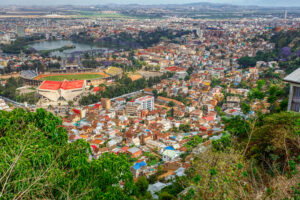
Aerial view of Antananarivo. Photo: Shutterstock
Most travelers treat Antananarivo as a necessary inconvenience. They land, sleep, and leave for the coast or the national parks as quickly as their itinerary allows. It is an understandable impulse. The capital of Madagascar is chaotic, loud, and does not present itself gently to visitors arriving without context. But written off too quickly, Tana — as locals call it — gives up very little of what it actually is.
A day and a half is not enough. It is, however, enough to understand why more time is worth it.
What the City Feels Like
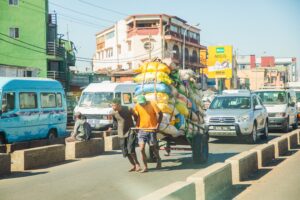
Antananarivo street traffic. Photo: Shutterstock
Antananarivo is loud in the way that most capitals are loud, and then louder. Cars move in every direction with a logic that takes time to read. People fill every pavement. Trucks rumble through narrow streets. Music spills from passing vehicles. Vendors call out from market stalls selling everything from counterfeit sneakers to fresh fruit to plastic toys.
The streets feel lived-in to a degree that sanitized tourist infrastructure never produces. This is a city going about its business, and visitors walking through it — especially alone, especially at night — will attract attention. Locals are not used to seeing tourists navigating independently after dark. The inquisitive looks are not hostile. They are simply the honest reaction of a city that does not see many people doing what you are doing.
The practical advice is simple: explore during the day, be aware of your surroundings, and do not dismiss neighborhoods based on a single street or a single impression. Tana is large and uneven, and one area tells you very little about the whole.
The Markets
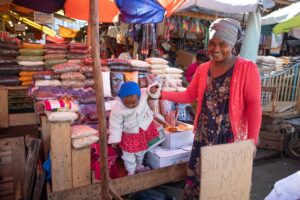
A vendor and her baby at Zoma market in Antananarivo. Photo: Shutterstock
The street markets are the most immediate entry point into daily Malagasy life in the capital. They are not curated for visitors. What is on offer ranges from the practical to the unexpected — fresh produce alongside electronics, fabric bolts next to children’s toys, food stalls operating alongside hardware vendors. The mix is specific to Tana and worth time.
The markets are also where the city’s character becomes most readable. The pace, the negotiation, the relationship between vendors and regulars — it is all visible, and it is a more honest introduction to Antananarivo than any official attraction provides.
What Tana Represents
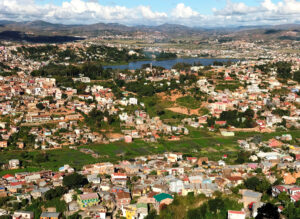
Panoramic view of Antananarivo. Photo: Shutterstock
Madagascar is a country of profound contrasts. It is extraordinarily rich in natural beauty, biodiversity, and cultural depth, and it carries the economic consequences of colonialism in ways that are visible everywhere — in the infrastructure, in the daily life of its people, in the gap between what the country has and what its people have access to. Antananarivo, as the capital, concentrates all of that in one place.
Spending meaningful time in Tana before heading to the national parks or the coast changes how the rest of the country reads. The baobabs and the lemurs do not exist in a vacuum. They exist in a country with a specific history and a specific present, and the capital is where that context is most available to a visitor willing to pay attention.
What to Do With More Time
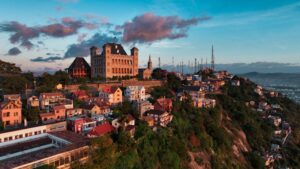
Aerial view of Antananarivo. Photo: Shutterstock
There is more to Tana than the street markets. The Rova of Antananarivo — the royal palace complex on the highest hill in the city — offers a view over the entire capital and a direct line into Malagasy history. The Analakely market is one of the largest in the country and worth at least a morning. The Musée d’Art et d’Archéologie holds a serious collection for anyone wanting context before heading into the country’s interior.
Two days in Antananarivo, approached with curiosity rather than impatience, is enough to arrive at the rest of Madagascar with a significantly fuller picture of what you are moving through.
Getting There
Antananarivo’s Ivato International Airport receives direct flights from Paris, Nairobi, Johannesburg, Réunion, Mauritius, and several regional hubs. It is the primary entry point for most international visitors to Madagascar and the natural starting point for any itinerary that takes the country seriously.