
Eagle Hunting in Mongolia: Meeting the Kazakh Eagle Hunters
A thousand-year-old tradition, still alive. Here is what it actually looks like up close
By Eizhelle Deguia | Published on May 26, 2026
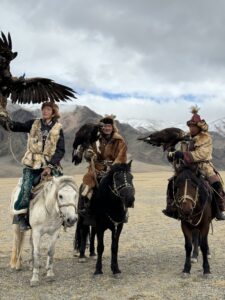
Hunters on horseback, holding their eagles. Photo: Young International
Most visitors who make it to western Mongolia come for the Olgii Eagle Festival. The crowds, the competition, the traditional dress — it is organized, accessible, and visually striking enough to justify the journey alone. But the festival is only the entry point. The more significant experience happens away from it, out on the steppe with a Kazakh family, where eagle hunting looks less like a spectacle and more like what it actually is: a way of life that has survived largely intact in one of the most remote corners of the world.
The tradition stretches across Central Asia — from Kyrgyzstan into Mongolia — and for those who have followed it from a distance, the Kazakh hunters of western Mongolia represent its most intact expression. Arriving with expectations of a large tourist festival, the reality confirmed one thing and complicated another: the bond between hunter and eagle is nothing like what most people imagine before they see it.
Getting There
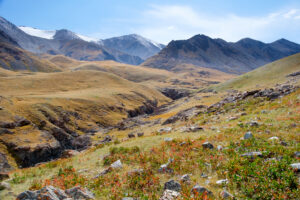
Western Mongolia terrain, golden rolling hills, snow peaks and wildflowers. Photo: Shutterstock
Western Mongolia does not have a direct route. The standard path runs through Ulaanbaatar first, then a domestic flight west to Bayan-Olgii — the regional capital and the closest thing to a hub in this part of the country. From Bayan-Olgii, the journey continues by road across rough, largely unpaved terrain. Depending on the destination, that drive can take hours. The landscape is open, stark, and enormous in a way that begins to prepare you for what the region actually is before you arrive anywhere specific.
Build the travel time into the itinerary and treat the journey as part of the experience rather than a logistical obstacle.
The Festival
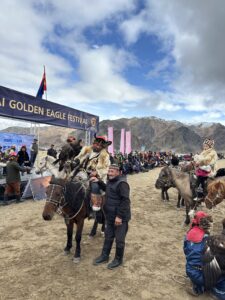
Golden Eagle Festival in Bayan-Olgii. Photo: Young International
The Olgii Eagle Festival takes place annually in early October and draws hunters from across the region to compete and demonstrate their skills. For a first-time visitor, it is the most efficient way to encounter the tradition: everything is organized, the hunters arrive dressed in full traditional clothing, and the range of what eagle hunting involves becomes visible in a compressed amount of time.
It is also where the misconceptions begin to fall away. The expectation — reasonably enough — is of a controlled performance, hunters directing trained birds through practiced routines. What becomes clear at the festival, and even clearer afterward, is that the dynamic between hunter and eagle is considerably more layered than that.
The Bond
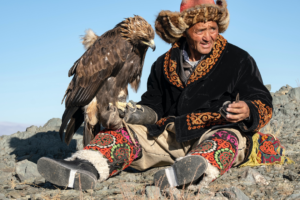
Older hunter with his eagle. Photo: Shutterstock
The most striking thing about eagle hunting is not the spectacle. It is the nature of the relationship between the hunter and the bird. The eagle is not a tool and is not treated as one. The bond is built on trust and developed over years — the eagle retains its own instincts and independence throughout. Hunters do not control their eagles so much as work alongside them, and that distinction is visible once you know to look for it.
For the Kazakh people of western Mongolia, this is not a tradition maintained for cultural tourism. It is historically tied to survival — to the realities of hunting across harsh terrain where working with the natural environment was not a philosophy but a necessity. That context does not disappear at the festival. It simply becomes easier to see away from one.
Beyond the Festival
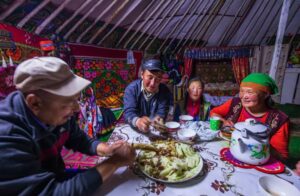
Kazakh eagle hunter family having dinner in their ger. Photo: Travel Buddies Mongolia
Spending time with a Kazakh family on the steppe outside the festival grounds is a different experience in almost every way. The crowds are gone. The pace slows. Eagle hunting in that context feels quieter and more personal — less about demonstration and more about the rhythms of daily life that have shaped this region for generations.
The festival is the right starting point. The real depth of the tradition becomes accessible once you move past it.
Why It Matters
What western Mongolia offers — and what eagle hunting specifically offers — is the experience of a way of life still operating in deep relationship with the land around it. In a world where that kind of continuity has largely disappeared, encountering it intact is not a small thing. The Kazakh golden eagle hunters of western Mongolia are not preserving a tradition for the benefit of visitors. They are living one. The distinction is worth making before you arrive, and impossible to miss once you’re there.
Getting There
Fly into Chinggis Khaan International Airport in Ulaanbaatar, then connect via domestic flight to Olgii Airport in Bayan-Olgii. MIAT Mongolian Airlines and Hunnu Air operate the route; flight time is approximately two to three hours. Ground transportation from Bayan-Olgii to festival and family visit locations should be arranged in advance through accommodation or a vetted local operator. The Olgii Eagle Festival takes place in early October — book well ahead as accommodation in Bayan-Olgii is limited and fills quickly around the festival dates.
The Numbers
Mongolia’s currency is the Tögrög (MNT). Budget guesthouses in Bayan-Olgii start around 30,000–50,000 MNT (9–15 USD) per night; mid-range options run 80,000–150,000 MNT (23–43 USD). Organized eagle festival tours including accommodation, transport, and guided access typically run 500–900 USD for three to five days booked through a tour operator. Independent travel is possible but logistically demanding — most first-timers use a local operator for at least the regional transport and family visit components. The festival runs in early October; the broader region is best visited between June and October before winter temperatures make travel significantly harder.