
Why Laos Is One of Southeast Asia’s Best Eco Travel Destinations
Fewer crowds, intact forests, and a tourism model built around not destroying what makes it worth visiting.
By Amina Mamaty | Published on May 27, 2026

Aerial view of Luan Prabang. Photo: Shutterstock
Somewhere along the way, eco-travel got a reputation for being a compromise. Rougher beds, simpler food, a vague sense that you were doing something good but enjoying yourself slightly less. Laos didn’t get that memo. The country has more intact forest than almost anywhere else in mainland Southeast Asia, more national protected areas per capita than its neighbors, and a tourism industry that — because it developed slowly and deliberately — never had to undo the damage of mass tourism in the first place. The result is a place where the most exclusive, most immersive experiences are also the most responsible ones. Not by accident. By design.
Luang Prabang was just awarded the Green Destinations Silver Level Certification in 2025 — the first city in Laos to receive it, recognized internationally for its approach to sustainability, waste management, and community-based tourism. Lonely Planet named it Asia’s top destination for 2025. The world is catching up to what thoughtful travelers have known for a while: Laos offers something increasingly rare — landscape, culture, and access that hasn’t been flattened into a product yet.
Sleeping in the Canopy
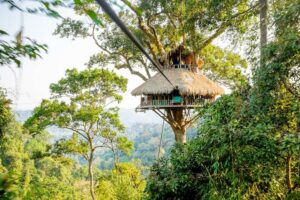
The Gibbon Experience treehouses suspended high in the forest. Photo: The Gibbon Experience
The Gibbon Experience in Bokeo Province is one of the most genuinely extraordinary things a traveler can do in Southeast Asia, full stop. The setup: visitors zipline through the canopy of Nam Kan National Park and sleep overnight in treehouses suspended up to 40 meters above the forest floor — among the highest in the world. Meals are cooked in nearby Hmong villages and delivered by zipline. The guides are entirely from local communities, many of them former loggers who now earn a living protecting the same forest they once worked against.
This is not adventure tourism with an eco sticker on it. The Gibbon Experience was built as a conservation project, and it shows. Revenue funds anti-poaching patrols and reforestation across the park. The project was instrumental in getting Nam Kan designated as a national park. Waking up above the treeline to the sound of black crested gibbon calls carrying through the mist — a species that is critically endangered and rarely seen — is the kind of moment that doesn’t have a price equivalent anywhere else in the region. The Classic and Waterfall experiences run two to three days. Book weeks in advance; it consistently sells out.
A Five-Star Lodge on the River
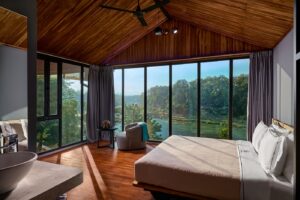
The NamKhan eco-lodge, riverside luxury accommodation. Photo: NamKhan Eco-Lodge
Just 15 minutes from Luang Prabang’s old town, The NamKhan sits on a bend in the Nam Khan River surrounded by gardens and its own organic farm. It is a member of Small Luxury Hotels of the World, holds Travelife Gold Certification for sustainability, and operates entirely on solar energy. The 24 accommodations — villas, river-view suites, and glamping tents with private terraces — are built from sustainable materials and designed to blur the line between indoors and out. Complimentary yoga classes run morning and evening by the river. The spa draws on traditional Lao healing practices. The restaurant serves from the farm.
The NamKhan is proof that the luxury and the responsibility are not in tension here — they are the same thing. Guests who want to spend a day at Kuang Si Falls and come back to an infinity pool and a riverside dinner under the stars are entirely accommodated. Those who want to go deeper — cooking classes, farm workshops, guided meditation, private alms-giving arrangements at dawn in Luang Prabang — will find those too.
Into the North
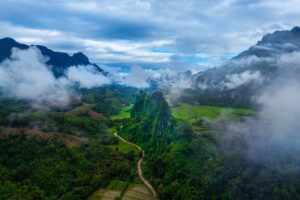
Nam Ha National Protected Area. Photo: Shutterstock
For travelers who want to get further off the map, Luang Namtha Province in the far northwest is where Laos eco-travel gets serious. The Nam Ha National Protected Area covers over 220,000 hectares of forest stretching toward the Chinese border — home to clouded leopards, Asian elephants, hornbills, and dozens of ethnic communities including the Akha, Khmu, and Lanten peoples. The Nam Ha Ecotourism Project, which won a United Nations Development Award and a British Airways Tourism for Tomorrow award in the early 2000s, runs multi-day treks with strict limits on group sizes, rotating routes to protect individual villages and trails, and local guides from the communities themselves.
Stays are in village homestays. The food is what the family cooks. The money goes directly to the people whose land is being walked through. It is not glamorous in the conventional sense — but it is exclusive in a way that no five-star hotel in Bangkok can replicate, because it cannot be scaled.
The Slow Boat Case
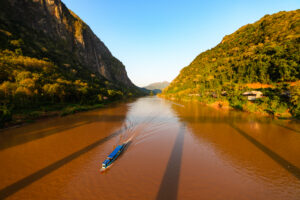
Slow boat or longtail moving through the Mekong. Photo: Shutterstock
Getting around Laos the slow way is not a budget choice — it is the right choice. The two-day slow boat journey from the Thai border down the Mekong to Luang Prabang passes through forested mountains and riverside villages that are inaccessible by road. A private charter makes it something else entirely: a moving suite on the water, stopping when and where it makes sense, with meals prepared on board and no itinerary beyond the river itself. Tour operators in Luang Prabang offer private Mekong charters for exactly this kind of travel — unhurried, unscripted, and deeply specific to this place.
The Nam Ou River north of Luang Prabang offers a similar experience at a smaller scale — a journey through dramatic karst landscape to villages like Nong Khiaw and Muang Ngoi that have embraced small-scale, community-run tourism precisely because the terrain has kept mass operators out.
Who It’s For
Laos eco-travel is for the traveler who has stopped being impressed by places that try too hard. It’s for someone who wants a trekking guide who grew up in the forest they’re walking through, a lodge that can name every ingredient on the dinner plate, a landscape that hasn’t been photographed into familiarity yet. The experiences here reward curiosity and patience — and they deliver something that is genuinely hard to find anymore: a place that feels like it’s being visited, not performed.
Best Time to Go
November through February offers the best conditions — dry, clear, and cool enough for trekking, river travel, and long evenings outside. October is an excellent shoulder month: the landscape is still lush and tourists are few. March and April bring rising heat and some smoke haze in the northern mountains. The rainy season from May through October turns the countryside dramatically green and waterfalls peak — river and canopy experiences remain possible, though some trekking routes are best checked ahead.
Getting There
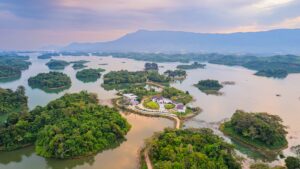
Luang Prabang from above at golden hour. Photo: Shutterstock
Luang Prabang is the main gateway, with direct flights from Bangkok, Hanoi, Singapore, and Chiang Mai. A high-speed rail line launched in 2021 now connects the city south to Vientiane. For Luang Namtha and the Gibbon Experience — based in Huay Xai — domestic flights from Luang Prabang are the most practical option. Private slow boat charters can be arranged directly through operators in Luang Prabang. Local currency is the Lao Kip (LAK); cash is essential for eco-lodges and rural experiences.