
Where Wine Was Born: How to Sip, Stay, and Indulge in Georgia
8,000 years of winemaking. One country that never stopped. Here’s how to do it properly.
By Amina Mamaty | Published on June 1, 2026
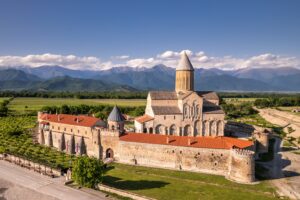
Vineyard in Kakheti, Caucasus Mountains. Photo: Shutterstock
France and Italy get all the attention. But Georgia was making wine before either of them existed as wine countries — before most of what we think of as European civilization had settled into place. Archaeological evidence dates Georgian winemaking back 8,000 years, predating France’s earliest wine production by more than five millennia. The method they developed — fermenting and aging wine in large clay vessels called qvevri, buried underground — is still in use today, still producing wines that taste like nothing made anywhere else on earth, and still recognized by UNESCO as an intangible cultural heritage of humanity.
This is not a destination that has recently discovered wine tourism. It is a destination where wine is woven so deeply into the culture that Saint Nino, one of Georgia’s most beloved religious figures, carried a cross made from a grapevine. Where the Tbilisi skyline’s most iconic monument — the giant aluminum Mother of Georgia — holds a bowl of wine in one hand and a sword in the other. Where it is considered impolite to refuse a glass. Georgia didn’t pivot to wine travel. Wine travel came to Georgia because it had no choice.
Start in Tbilisi

Bar area at Kazbegi hotel in Tbilisi. Photo: Kazbegi Hotel
Most travelers arrive through Tbilisi, and the capital is a genuinely excellent place to start understanding Georgian wine before going deeper into the regions. The natural wine bar scene here has been building for years and is now among the most interesting in Europe — small, serious, and deeply connected to the producers making wine in cellars across the country.
Vino Underground, a basement bar in the Old Town stocking around 350 bottles from Georgia’s most experimental natural producers, is the place most in the know head to first. Many of the wines here come from winemakers who don’t sell anywhere else — unlabeled bottles from small family operations that produce a few thousand bottles a year and consider that sufficient. G.Vino in Vake curates rare natural wines and pairs them with tapas-style plates in a setting that feels appropriately serious without being precious. 8000 Vintages — the name a reference to those eight millennia of winemaking — runs multiple locations across Tbilisi and now Batumi, with a professional sommelier at each who can walk any level of wine drinker through the country’s key styles and regions. Craft Wine Restaurant likely holds the largest natural wine list in the city, sourcing from all of Georgia’s regions.
What to order: start with an amber wine — white grapes fermented with skin contact in qvevri, producing that distinctive orange-amber color and tannic, textured profile that is Georgia’s most unique contribution to the wine world. Then move to a dry Saperavi red, the country’s most planted red grape, dark and full-bodied in a way that has no real European equivalent. Say gaumarjos — cheers — every time someone pours.
Go to Kakheti
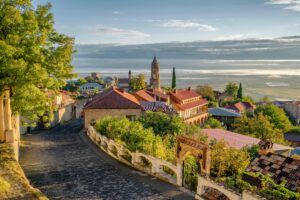
The Alazani Valley in Kakheti. Photo: Shutterstock
Kakheti is where 70 to 80 percent of Georgia’s wine is produced, and the two-hour drive east from Tbilisi into the Alazani Valley — vineyards spreading across the valley floor, the Greater Caucasus rising behind them — makes the case for the region before a single bottle is opened. This is Georgia’s wine heartland, and it looks and feels the part.
The region’s key towns are Sighnaghi and Telavi. Sighnaghi — often called the City of Love — sits on a hill surrounded by 18th-century stone walls, with views over the valley and mountains that stop people mid-sentence. It is small, walkable, and entirely oriented around wine and food. Pheasant’s Tears, owned by American artist and winemaker John Wurdeman and staffed by a local chef, is the most renowned restaurant in Kakheti — pairing the winery’s own natural qvevri wines with a rotating seasonal menu. Telavi, the regional capital, has its own charm: the Tsinandali Estate, a 19th-century property where the first bottle of Kakhetian qvevri wine was corked in the European style in 1841, now operates as a hotel and restaurant with a remarkable enoteca of vintage Georgian bottles.
The real Kakheti experience, though, happens at smaller scale. Family wineries producing under 15,000 bottles a year, where lunch is cooked by the winemaker’s mother and the tasting happens at the same table where the family eats dinner. Operations like Okro’s Wines in Sighnaghi, making organic wines entirely by hand from indigenous varieties including Rkatsiteli, Mtsvane, and Saperavi. The Khareba Wine Cave in Kvareli, a 7.7-kilometer tunnel carved into the Caucasus Mountains where natural temperature and humidity provide ideal aging conditions — one of the more singular cellars on earth.
Château Buera, Lopota Lake

Château Buera at Lopota Lake. Photo: Young International
For those who want to stay in the wine country rather than day-trip through it, Château Buera at Lopota Lake Resort in Kakheti is the reference point. Set on a private lake surrounded by vineyards and mountains, it combines a working winery with genuinely luxurious accommodation. Guests can visit the wine cellar, participate in harvest season activities, and eat well from a kitchen that takes the local produce seriously. It is the right base for a wine-focused stay in Kakheti, and the lake views make it hard to leave. (Read our full stays review here.)
What Makes Georgian Wine Different
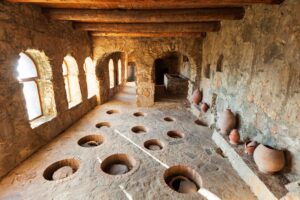
Georgian wine cellar with wine stored in “qvevris”. Photo: Shutterstock
Georgian wine earns its reputation not through marketing but through genuine distinctiveness. The qvevri method — grapes crushed and fermented together with their skins, seeds, and stems inside the buried clay vessel for months without intervention — produces wines that feel more alive and more unpredictable than anything made in stainless steel or oak. The amber wines especially: their color, their tannins, their depth of flavor have no real precedent in the European canon. Every bottle is slightly different because every qvevri is slightly different, and the winemaker’s role is less about control and more about trust.
The grape varieties themselves add another layer of uniqueness. Georgia has over 500 indigenous varieties, the vast majority of which are grown nowhere else. Rkatsiteli, the dominant white, can be made crisp and European in style or fermented in qvevri into something amber, textured, and complex. Saperavi, the main red, has both red skin and red flesh — one of the few grape varieties where the juice itself is deeply colored — producing wines with concentration and structure that age well and reward attention. Mtsvane, Kisi, Chinuri, Khikhvi — varieties that appear on no French or Italian wine list and whose names most of the world has never encountered.
The Supra
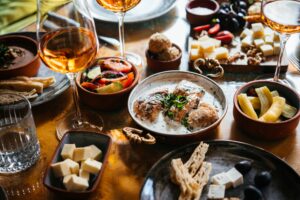
Georgian food spread. Photo: Shutterstock
Wine in Georgia is inseparable from the table, and the table in Georgia is inseparable from the supra — the traditional feast that is less a meal than a ritual. A tamada, or toastmaster, leads the table through a series of toasts that begin with God and country and work their way through friendship, love, the absent, the departed, and whatever else the moment requires. Wine flows between toasts. Food arrives continuously. The expectation is that you will stay, drink, eat, and mean it.
Even a restaurant meal in Georgia carries some of this energy. Order badrijani nigvziani — fried eggplant rolled around a walnut paste — alongside a plate of pkhali, the dense herb and walnut balls that appear at every table. Add khinkali, eaten by hand and with a technique locals will correct without being asked. Pour a Saperavi. When someone raises a glass, raise yours. Say gaumarjos. This is how Georgia has always done it, and it is still the best version of a dinner that exists.
Who It’s For
Georgia wine travel is for anyone who has done Tuscany and Burgundy and wants to go somewhere that feels genuinely undiscovered by comparison. For wine lovers who want to drink things that exist nowhere else. For travelers who understand that the best meals are the ones that go on too long and end with someone pouring chacha from an unlabeled bottle. And honestly, for anyone who wants to understand a country through the thing it cares about most — because in Georgia, wine is not a product. It is the culture.
Best Time to Go
September and October are the peak wine travel months — harvest season, called Rtveli, transforms Kakheti into a celebration of grape-stomping, feasting, and new wine. Spring, when the qvevri are opened and the new vintage is tasted for the first time, is equally compelling for wine travelers. Summer is warm and beautiful in the valleys. Winter is quiet and cold but the wine bars in Tbilisi are warm and open late.
Getting There
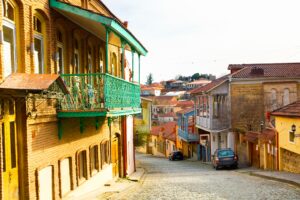
Tbilisi Old Town at dusk. Photo: Shutterstock
Tbilisi International Airport receives direct flights from major European hubs, Istanbul, Tel Aviv, Dubai, and beyond. Kakheti is a 1.5 to 2-hour drive from Tbilisi — private transfers are the most practical option for winery visits. For the Lopota Lake area and Château Buera, the drive runs approximately 2.5 hours from Tbilisi. Local currency is the Georgian Lari (GEL). Wineries generally accept card payments; family operations and village markets are cash-preferred.