
Grand-Bassam to Assinie: The Côte d’Ivoire Coast Beyond Abidjan
Forty kilometres east of Abidjan, two of West Africa’s most compelling coastal destinations sit on the same stretch of Atlantic shoreline. Almost nobody outside of Côte d’Ivoire is talking about either of them.
By Amina Mamaty | Published on May 6, 2026
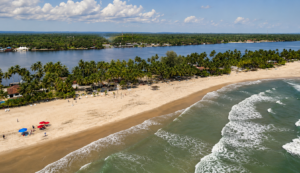
Assinie Beach. Photo: Shutterstock
The road east of Abidjan is not the road most travelers take. It should be. Within an hour and a half, it delivers you to two destinations that together make one of the strongest cases for Côte d’Ivoire as a place worth your time — a UNESCO-listed colonial town where history walks beside you in the streets, and a sun-drenched peninsula caught between a lagoon and the Atlantic that the French have been calling their Saint-Tropez for decades. The international travel world has largely missed both. That is its loss and, for now, your advantage.
Grand-Bassam — The First Capital
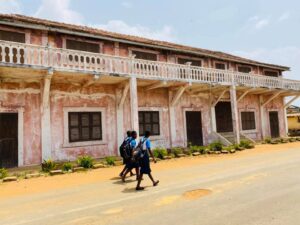
Colonial houses in Grand-Bassam. Photo: Flickr
Grand-Bassam was the first capital of Côte d’Ivoire, from 1893 to 1900. Its old colonial quarter — the Quartier France — is the best-preserved of its kind in the country, and has been a UNESCO World Heritage Site since 2012. That designation matters not because it makes the place feel like a museum, but because it explains the particular quality of the streets: wide, quiet, full of buildings that have absorbed over a century of Atlantic air and are still standing.
The Quartier France was built on a narrow strip of land between the ocean and the lagoon. Its colonial houses — with their wide verandas, exterior galleries, and overgrown gardens — tell the story of a city that was once the center of everything, and then wasn’t. The Governor’s Palace, now the National Museum of Costume, dates to 1893. The old Palais de Justice stands heavily weathered across from it. The former Post Office still has its mail boxes, open and obviously unused. The Maison des Artistes, a building that was once a French warehouse, has been taken over by local artists who painted their portraits across its crumbling walls. It is that kind of place — layered, surprising, and entirely its own.
The most powerful stop in the district is easy to miss. On the exterior wall of what was once the country’s first supermarket, a mural tells the story of the Women’s March of 1949 — the day Ivorian women walked from Abidjan to Grand-Bassam to demand the release of their husbands, brothers, and sons who had been jailed without trial for speaking out against French colonial rule. Many were beaten. None turned back. A statue in the Place de la Paix commemorates three of the women who led the march: Anne-Marie Raggi, Marie Sery Koré, and Odette Ekra. It is the kind of history that does not appear in most travel guides. It is also the kind that makes a destination worth the trip.
Beyond the colonial quarter, Grand-Bassam is a working beach town with real energy. The beach runs for kilometres along the Atlantic and is one of the best surf spots in the country. The restaurants along the waterfront are local and unpretentious — Assoyam Beach is the institution for fresh seafood, where the lobster and plantains are the right order and the owner Koffi always has a story. The Blue Box offers a livelier, more international menu and stays busy well into the evening.
Assinie — Where the Lagoon Meets the Ocean
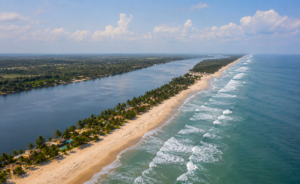
Assinie Beach from the sky. Photo: Shutterstock
An hour east of Grand-Bassam, the Ivorian coast does something remarkable. Assinie sits on a narrow strip of land with the lagoon on one side and the Atlantic on the other — two completely different bodies of water separated by nothing but pale sand and palm trees. You can swim in the calm, warm lagoon in the morning and walk ten minutes to open ocean by afternoon. There is nowhere else on the West African coast quite like it.
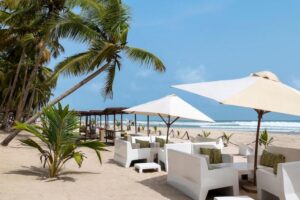
Beachfront at Coucoué Lodge in Assinie. Photo: Coucoué Lodge
The town was once a fishing village. Today it has elegant hotels, private villas, seafood restaurants, and beach clubs that draw Abidjanais every weekend without fail. It has been called the Saint-Tropez of Africa, and the comparison is not entirely wrong — the French influence shows up in the food, the wine, the aesthetic of the better resorts. But Assinie has none of Saint-Tropez’s self-consciousness. The ocean breezes, the pale sand, the blue skies and warm water arrive simply, without making a fuss. The place is not performing luxury. It just happens to be beautiful.
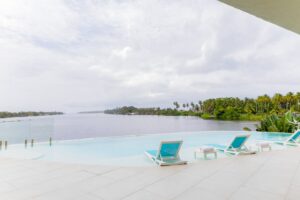
Photo: Palms Resort Assinie managed by Accor
Where to stay depends on what you want. The Zion Hotel sits on the lagoon side with lush bungalows and a free pirogue crossing to the beach — you wake up to lagoon views and reach the Atlantic in minutes. Le Bahia is at the far end of the strip, right where both the pool and the beach share the same property, with open ocean visible from the bedroom window. Villa Tiba sits further out, facing the Ehotilé island archipelago — overwater bungalows, total quiet, and the kind of sunset that makes people cancel their return flights. The newest property generating the most local buzz is the Palm Resort: sky lounge, infinity pool, spa, private pontoon, and a kitchen serious enough to match all of it.
The lagoon itself is an attraction. Pirogue rides, jet skiing, fishing, and buying seafood directly from local fishermen are all part of the rhythm here. At the point where the lagoon meets the ocean, the sunset puts on a show that has no equal on this stretch of coast. For those who want to go further, the Ehotilé Islands national park sits just beyond the peninsula — accessible by boat, home to rare wildlife, and almost unknown outside of Côte d’Ivoire.
As Ivorian artist Didi B said about the place: Assinie, c’est la base. Assinie, c’est le chill. Mais pour le voir, faut y aller. Assinie is the vibe (“Assinie is the foundation. Assinie is the chill. But to really understand it, you have to go there. Assinie is the vibe”.) But you have to go to understand it.
Getting There
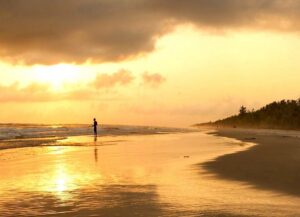
Beautiful sunset in Assinie. Photo: Shutterstock
Grand-Bassam is about 40 kilometres east of Abidjan — under an hour by road. Assinie is another 90 kilometres beyond that, roughly two hours from the city in total. The coastal road connects them directly, which makes a two or three-day trip easy to plan: a morning in the colonial quarter, an afternoon on Grand-Bassam’s beach, then east to Assinie for a couple of days of doing very little very well. The best time to visit is November through April, when the dry season brings clear skies and calm water. The rest of the world’s tourist circuit will be somewhere else. This coast will be, as it almost always is, quietly to itself.