
Georgia at the Crossroads of Europe and Asia: A Cultural Identity Explained
Is Georgia Europe or Asia? It doesn’t fit neatly into either continent. Georgia built an entire civilization in the space between.
By Amina Mamaty | Published on June 1, 2026
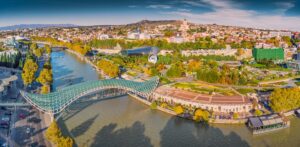
Tbilisi from the sky. Photo: Shutterstock
Most people, when they first hear about Georgia as a travel destination, pause for a second. Europe or Asia? The question is not unreasonable. Georgia sits at the bottom of the Caucasus Mountains — bordered by Russia to the north, Turkey and Armenia to the south, Azerbaijan to the east, and the Black Sea to the west. Depending on who you ask and which map you’re looking at, it falls in Europe, or in Asia, or in a zone that neither continent has a clean claim on. The honest answer is that it sits at the edge of both — and that position, held for several thousand years, is exactly what shaped one of the most layered and genuinely surprising cultures on earth.
This is not a country that got stuck between two worlds. It is a country that was built at the meeting point of several, absorbed what passed through, and turned all of it into something entirely its own.
So Where Exactly Is It?
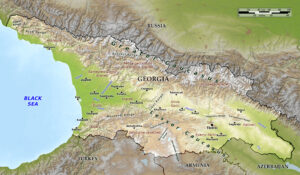
Map of Georgia. Photo: Shutterstock
Georgia is in the South Caucasus — a region that sits south of the Greater Caucasus mountain range, which is commonly used as the boundary between Europe and Asia. By strict geography, most of Georgia falls on the Asian side of that line. But geography is only part of the story. Georgia is a member of the Council of Europe. It competes in Eurovision. It has been an official EU candidate country. Its population is overwhelmingly Christian — Eastern Orthodox, one of the oldest Christian nations on earth, having adopted the faith in 326 AD. Its cultural and political orientation has historically pointed west.
The short version: Georgia is physically in the South Caucasus, culturally aligned with Europe, and shaped by centuries of contact with the Middle East, Persia, and the Ottoman world. None of those things cancel each other out. They are all simultaneously true, and they are all visible the moment you arrive.
A Language That Belongs to No One Else
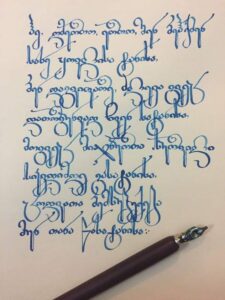
Georgian script, “Mkhedruli”, on paper. Photo: Shutterstock
The most immediate reminder that Georgia is genuinely its own thing is the alphabet. Georgian is written in Mkhedruli — a flowing, rounded script that looks like nothing in Europe or Asia, because it is related to nothing in Europe or Asia. The Georgian language belongs to the Kartvelian family, which has no connection to Indo-European languages, no connection to Arabic or Turkic languages, no common root with Russian or Persian or Turkish or anything spoken by any of its neighbors. It developed here, survived here, and is still spoken here — one of the oldest continuously used languages on earth.
Walking through Tbilisi and reading the signs is one of the quieter pleasures of arriving in Georgia for the first time. The script is beautiful and completely foreign, and it is the clearest signal that whatever Georgia is, it is not a version of somewhere else.
What the Silk Road Left Behind
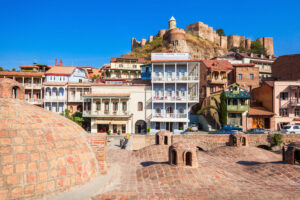
Old Tbilisi. Photo: Shutterstock
For most of its history, Georgia sat directly on the Silk Road — the ancient trade network connecting China to the Mediterranean. Every civilization that moved through left something behind. Persian architecture shaped the bathhouse district. Byzantine Christianity shaped the monasteries and the music and the way the calendar is organized around religious festivals. The Ottomans left their mark on the cuisine and the coffee culture. The Mongols passed through. The Russians arrived and stayed for two centuries. Each layer is still visible in Tbilisi’s skyline, in the food on the table, in the carvings on the balconies of the old city.
The result is a visual and culinary culture that is immediately distinctive precisely because it contains so many influences — and because it transformed all of them into something recognizably Georgian. The wine tradition, 8,000 years old and made in buried clay vessels called qvevri, exists nowhere else. The polyphonic singing, recognized by UNESCO, sounds like nothing in Europe or Asia or anywhere in between. The food — built around walnuts, pomegranate, tarragon, blue fenugreek — shares flavors with the Middle East and the Caucasus but belongs to neither. Georgia took from everyone and made something that no one else made.
The Soviet Chapter and What Came After
Georgia spent seventy years inside the Soviet Union — long enough to leave Russian as the second language of an entire generation, Soviet-era architecture scattered across the city, and a complicated relationship with Moscow that continues today. Independence came in 1991, and with it a deliberate return to Georgian identity: the language, the Orthodox church, the wine made the old way, the songs that had been quietly kept alive through everything.
That return is still underway and still very much felt on the ground. Tbilisi today is one of the most energetic cities in the region — a young, creative, internationally oriented capital that is simultaneously wrestling with its political future and investing in its cultural past. The tension between tradition and modernity, between European aspiration and regional pressure, between the old city and the new development going up around it — all of that is part of what makes it genuinely alive in a way that more settled destinations often are not.
Why It Matters for the Traveler
Georgia is not a difficult country to visit — but it rewards travelers who arrive with some understanding of what they are looking at. The sulfur baths make more sense when you know the city was literally founded because of the hot springs beneath them. The wine means more when you understand that the method hasn’t changed in eight millennia. The monasteries feel different when you know they were the institutions that kept the Georgian language and Georgian identity alive through every occupation and every attempt to replace them with something else.
And beyond Tbilisi, the country keeps giving. Kakheti to the east with its vineyards and family wineries. Batumi on the Black Sea coast — a beach city with a genuinely cosmopolitan energy that surprises most people who have never heard of it. The Caucasus mountains in the north, some of the most dramatic high-altitude landscapes in Europe or Asia or whatever you want to call this part of the world.
Georgia is worth going to. It is also worth understanding before you go — because what you find there is stranger, older, and more interesting than almost anywhere else on the map.
Getting There
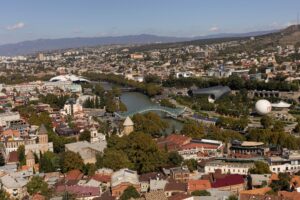
Tbilisi from above. Photo: Shutterstock
Tbilisi International Airport receives direct flights from major European hubs, Istanbul, Dubai, Tel Aviv, and cities across the former Soviet space. The city is walkable in its historic center and well connected by public transport. Bolt is the go-to ride app. The local currency is the Georgian Lari (GEL); most restaurants and hotels accept cards. For everything else you need to know before your first trip — visa requirements, getting around, cultural etiquette, and where to eat — read our full first-timer’s guide to Georgia.