
Copacabana and the Island of the Sun: Bolivia’s Most Sacred and Stunning Corner
Most people fly into La Paz, do the salt flats, and leave. Isla del Sol, Bolivia—one of the most important cultural and historical sites on Lake Titicaca, remains surprisingly overlooked by travelers. It offers an entirely different side of Bolivia.
By Amina Mamaty | Published on June 3, 2026
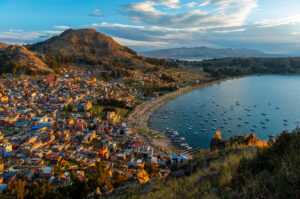
Sun setting over Copacabana and Lake Titicaca. Photo: Shutterstock
Most travelers who come to Bolivia do the salt flats, do La Paz, and leave. Which is fine. Both are worth it. But Copacabana and the Island of the Sun sit two hours from the capital and almost nobody makes the trip. That is the part that is hard to explain, because once you are standing at the edge of Lake Titicaca watching the Andes reflect off water that has no business being that blue at that altitude, the question stops being why you came and starts being why it took so long.
Most people who do make it to Lake Titicaca do so from the Peruvian side. Puno, the floating reed islands, the organized tourist circuit. The Bolivian shore is quieter, less built around the visitor, and by most accounts the more extraordinary of the two. Copacabana sits on a peninsula jutting into the southern end of the lake. The Island of the Sun, Isla del Sol, sits in the water a short boat crossing away and is, according to Inca cosmology, the birthplace of the sun itself. Together they form one of the most significant corners of the Americas. Together they are consistently left off the Bolivia itinerary.
The Lake
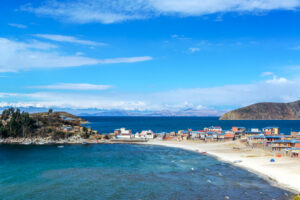
Copacabana and Lake Titicaca . Photo: Shutterstock
Lake Titicaca is the highest navigable lake in the world at 3,812 metres above sea level. That fact sounds like a trivia answer until you are actually there, and then it explains everything. The color of the water at that altitude is not something photographs fully prepare a visitor for. It is a deep, saturated blue that comes from altitude, clarity, and the particular quality of light that exists above 3,500 metres. The lake covers over 8,000 square kilometres, and from the shore at Copacabana the far edge is not visible. It genuinely reads as an ocean that has been placed in the mountains.
From Copacabana the lake fills the entire horizon. The Andes frame it on every side. There is nowhere in the town where the water is not visible, and that constant presence builds over the course of a day in a way that is specific to places built directly on the water’s edge at altitude. It gets under the skin slowly. By the second evening it is difficult to imagine leaving.
Copacabana Town

The Basilica of Our Lady of Copacabana. Photo: Shutterstock
Copacabana is a pilgrimage town before it is a tourist town, and that distinction matters more than it sounds. The Basílica de Nuestra Señora de Copacabana, a striking white Moorish-influenced cathedral built in the 16th century, draws Catholic pilgrims from across Bolivia and Peru throughout the year. On weekends the vehicle blessing tradition happens outside the basilica: cars, trucks, and buses decorated with flowers and streamers, doused with beer and blessed by a priest. It is completely specific to this place and entirely worth timing a visit around if the dates line up.
The waterfront market, fresh trout grilled straight from the lake, streets that fill with pilgrims and travelers in roughly equal measure. Copacabana runs at its own pace. Small enough to walk completely in an hour, interesting enough to stay in for three days. Most travelers passing through on the way to the Island of the Sun give it one night. That is not enough time.
The Boat Crossing
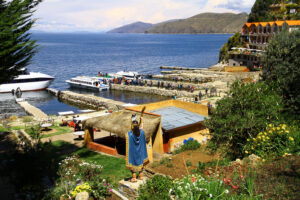
Copacabana dock. Photo: Shutterstock
The crossing from Copacabana to the Island of the Sun takes roughly ninety minutes by boat, and the crossing itself earns its place in the memory of the trip. The lake at altitude has a stillness on calm days that produces an unusual clarity. The blue deepens as the shore recedes. The mountains that ring the lake come into full view. The island grows slowly from a dark shape on the horizon into terraced hillsides and Inca stone walls.
This is water that Andean civilizations have considered sacred for thousands of years. The Inca believed the sun rose from this lake for the first time. Crossing it with that knowledge changes what it feels like to be on the water. It is not just a transfer. It is the approach.
Isla del Sol, Bolivia
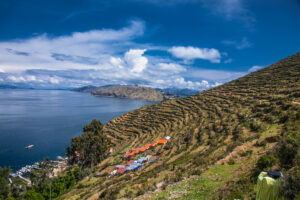
Small village on Isla del Sol. Photo: Shutterstock
No cars, no paved roads, and a population of Aymara communities who have farmed these terraced hillsides for centuries.
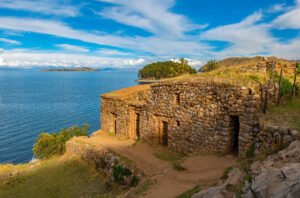
Inca ruins on Isla del Sol. Photo: Shutterstock
The Inca ruins here, including the Chincana labyrinth in the north and the Pilkokaina temple in the south, are among the most significant on the lake. They sit in a landscape that makes the walk between them as compelling as the ruins themselves. The views from the island’s ridge looking back toward Bolivia are the ones that stay longest. The lake stretches in every direction. The Bolivian Andes rise across the water. The altitude light gives everything a sharpness that lower elevations simply do not produce. On a clear day the snow-capped Cordillera Real is visible across the water, a wall of peaks behind the lake that looks too large to be real.
Two days is the right amount of time. Arrive in the afternoon. Spend the night at one of the lodges on the southern end. Walk the length of the island the following morning before the day boats arrive from Copacabana. The north has the most significant ruins and the south has the better sunset.
Getting There and What to Know
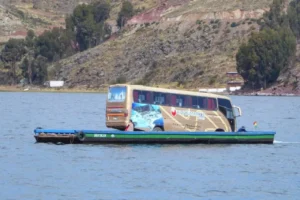
Barge transporting a bus across the Strait of Tiquina on Lake Titicaca. Photo: Shutterstock
Copacabana is a three to four hour bus journey from La Paz. The route passes through the Tiquina Strait, where passengers get off and cross the water by small motorboat while the bus crosses separately on a flat-bottomed ferry. It sounds like an inconvenience. It is one of the more specific and memorable stretches of the whole journey, the kind of thing that ends up in the story of the trip.
Boats to the Island of the Sun depart from Copacabana’s waterfront each morning, with return departures in the afternoon. Most operators serve both the north and south ends of the island. Accommodation on the island is basic, small family-run guesthouses with limited electricity, and that simplicity is entirely appropriate to what the island is. The experience holds up completely without the luxury.
May through October is the window to aim for. Dry season, calm lake, clear skies, and the best light on the water. Coming from La Paz rather than from sea level makes the altitude adjustment considerably more manageable, which matters more at 3,800 metres than most people expect before they arrive.
The Peruvian side of Lake Titicaca is easier to reach and more developed for tourism. The Bolivian side is the one that travelers who have seen both consistently recommend. Copacabana and the Island of the Sun are why.