
Lake Khövsgöl: Mongolia’s Dark Blue Pearl
Most people have never heard of it. The ones who have can’t stop talking about it.
By Amina Mamaty | Published on May 26, 2026
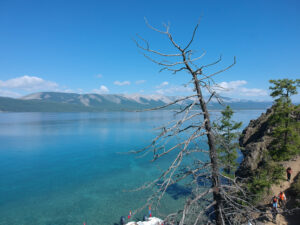
Lake Khövsgöl. Photo: Shutterstock
In the far north of Mongolia, close enough to the Russian border that the landscape starts to feel Siberian, there is a lake so large, so clear, and so deeply blue that Mongolians have called it the Dark Blue Pearl for generations. Lake Khövsgöl holds more than seventy percent of Mongolia’s fresh water and roughly two percent of the world’s total surface fresh water — making it one of the most significant bodies of fresh water on the planet. It is also, by almost any measure, one of the most beautiful places in Central Asia.
The lake stretches 136 kilometers from north to south and sits at an elevation of 1,645 meters above sea level, ringed by mountains that rise to over 3,000 meters and forests of Siberian larch and pine that would not look out of place in the Canadian wilderness. The water is cold enough to swim in for only the bravest visitors and clear enough to see the bottom in the shallows. In winter, it freezes solid — thick enough to drive across — and becomes the stage for one of Mongolia’s most surreal annual events, the Khövsgöl Ice Festival. In summer, it turns a shade of blue that photographs can approximate but never quite capture.
Getting There
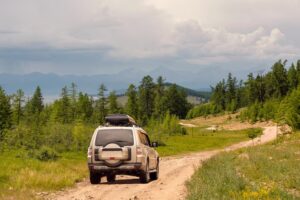
Road leading to Lake Khövsgöl. Photo: Shutterstock
Khövsgöl is not a destination you stumble upon. The lake sits approximately 800 kilometers from Ulaanbaatar — a domestic flight to the town of Mörön, followed by a 100-kilometer road transfer to the lake’s main gateway town of Khatgal, is the most practical route. The flight takes roughly an hour and a half; the transfer another two to three hours depending on road conditions. The road from Mörön to Khatgal is paved in parts and unpaved in others, and the journey is already part of the experience — the landscape shifts gradually from open steppe to rolling hills to the edge of the taiga, and by the time the lake appears through the trees, the sense of arrival is earned.
Domestic flights from Ulaanbaatar to Mörön operate seasonally and fill quickly during peak summer months. Book well ahead — ideally at the same time as your main international flights.
What to Do
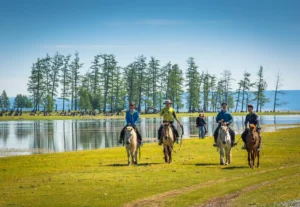
Horseback riding along the lakeshore. Photo: Shutterstock
The lake and its surroundings reward slow travel. Horseback riding along the shoreline and through the taiga forest is the definitive Khövsgöl experience — trails wind through terrain that feels entirely untouched, and the scale of the landscape becomes clear only from the saddle. Hiking is equally rewarding for those who prefer their own feet, with routes ranging from gentle lakeshore walks to more demanding ascents into the surrounding mountains.
The lake itself is navigable by boat from Khatgal, with longer excursions reaching the northern shores where few tourists venture. Kayaking and fishing are also on offer during summer months. In winter, the Ice Festival in early March transforms the frozen surface of the lake into a venue for ice skating, dog sled races, horse-drawn sleigh competitions, and shamanic ceremonies — one of the more extraordinary things a traveler can witness in Mongolia and one of the few festivals that makes a compelling case for visiting the country in February.
The Tsaatan
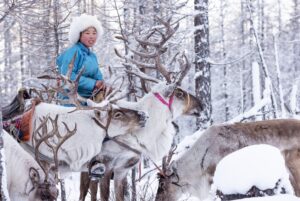
Tsaatan reindeer herder in the taiga. Photo: Shutterstock
North of Lake Khövsgöl, deeper into the taiga, live the Tsaatan — one of the last reindeer-herding peoples on earth. Numbering only in the hundreds, the Tsaatan have maintained their nomadic way of life for centuries, moving with their reindeer herds through some of the most remote terrain in Asia. They live in teepee-like structures called ortz rather than gers, and their culture — language, spiritual practice, relationship with their animals — is distinct from the broader Mongolian nomadic tradition.
Visiting a Tsaatan community requires advance planning, a responsible tour operator, and genuine respect for a community that is actively working to preserve its way of life in the face of significant pressure. It is not a tourist attraction. It is a privilege, and one worth approaching accordingly. Several reputable operators based in Khatgal and Ulaanbaatar organize respectful community visits that benefit the Tsaatan directly.
Where to Stay
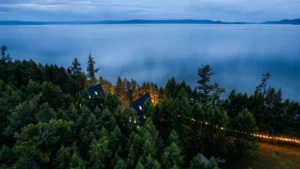
Double Lake by Toilogt luxury ger camp on the lakeshore. Photo: Double Lake by Toilogt
Accommodation around Khövsgöl ranges from basic tourist ger camps in Khatgal to remote luxury options further along the shoreline. For travelers who want the full Khövsgöl experience without sacrificing comfort, Double Lake by Toilogt — situated on twin glacial lakes just south of Khövsgöl — is the standout choice in the region. Read our full stay feature for everything you need to know about the property [hyperlink here].
For those staying closer to Khatgal, several established ger camps sit directly on the lakeshore and offer a simpler but deeply atmospheric base. The sound of the lake at night — the water moving against the shore, the forest quiet around it — is worth the journey alone.
When to Go
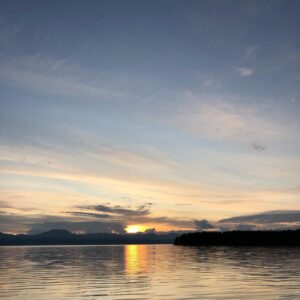
Lake Khövsgöl at sunset. Photo: Young International
Late June through August is peak season at Khövsgöl, when the lake is at its warmest, the surrounding meadows are green, and the days are long enough to make the most of the landscape. The Naadam Festival in July adds a cultural dimension to a summer visit — local celebrations are held in Khatgal and the surrounding area in a more intimate form than the big national event in Ulaanbaatar.
For the Ice Festival, plan for early March and prepare for serious cold — temperatures regularly drop below -20°C. The experience is worth it, but warm layers are non-negotiable.
September and early October offer a quieter, golden version of the lake — the larches turn, the crowds thin, and the light shifts into something close to amber. It is arguably the most beautiful time to be there and one of the least visited windows of the year.
The Numbers
Domestic flights from Ulaanbaatar to Mörön run approximately $80–$150 USD each way depending on season and how far in advance you book. Transfer from Mörön to Khatgal adds another hour or two by road. Ger camps around the lake range from $30–$80 USD per night including meals for standard options; luxury properties sit higher. The lake area is accessible from late May through October for standard visits; winter access requires more planning and appropriate cold-weather preparation. Mongolia requires a visa for most nationalities — check entry requirements well in advance.