
Luang Prabang: Laos’ UNESCO Town Worth Slowing Down For
The Mekong. Monks at dawn. And a town that makes the rest of Laos look like it needs to calm down.
By Amina Mamaty | Published on May 27, 2026
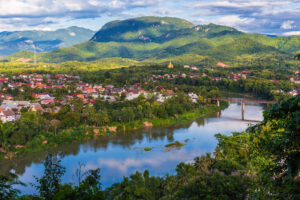
Luang Prabang’s peninsula. Photo: Shutterstock
If Laos were a family, Luang Prabang would be the older sister who has always had her life together. Elegant without trying. Calm without being boring. While Vientiane is doing its thing and Vang Vieng is catering to backpackers, Luang Prabang is just existing quietly on a peninsula in northern Laos where two rivers meet — and honestly, it doesn’t need to compete with anyone.
It’s a small town. You can walk from one end to the other in 20 minutes. There are no billboard advertisements, no big trucks rolling through, no neon signs fighting for attention. What there is: golden temples, tree-lined streets, French colonial buildings that somehow still look good, a Mekong riverbank made for doing nothing, and food that deserves its own article. Luang Prabang is a UNESCO World Heritage Site, which basically means the whole town is protected — nothing gets torn down, nothing gets replaced with a concrete eyesore. It looks now much like it did decades ago, and that’s entirely the point.
The Town
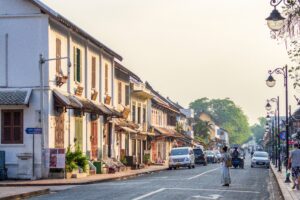
Colonial buildings in Luang Prabang old town. Photo: Shutterstock
The temples here are called wats, and there are over 30 of them packed into a very small area. Wat Xieng Thong is the one everyone talks about — dramatic rooflines, intricate gold detail, sitting right at the tip of the peninsula where the Mekong bends. It’s genuinely stunning and worth more than a quick photo stop. The Royal Palace Museum nearby is worth an hour of anyone’s time too, mostly for the building itself and the gold artifacts inside.
In the center of town, Phousi Hill is a 300-step climb that pays off immediately at the top. Both rivers appear below on either side, limestone mountains in the background. Go at sunset. It’s one of those views that doesn’t need a filter.
The streets themselves are the real attraction though. Rent a bicycle, pick a direction, and just go. Every turn leads somewhere worth seeing.
The Ritual
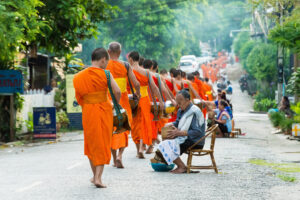
Monks at the Tak Bat alms-giving ceremony. Photo: Shutterstock
Every morning before sunrise, hundreds of monks walk silently through the streets collecting food offerings from locals kneeling along the roadside. It’s called Tak Bat, and it has happened here every single day for over 600 years. The whole thing lasts about 30 minutes and it is completely, genuinely moving — even for people who aren’t particularly spiritual.
It starts around 5:30 AM on Sakkaline Road. Get there early, cover up, and keep distance. This is a real daily tradition for the community, not a tourist attraction — treat it that way and the experience is something else entirely.
Beyond the Peninsula
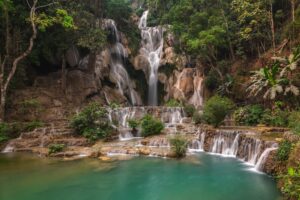
Kuang Si Waterfalls. Photo: Shutterstock
About 30 kilometers outside of town, Kuang Si Waterfalls have turquoise pools that look completely fake in photos and even more unreal in person. The water is that color naturally — something to do with the limestone. Swimming is allowed in the lower pools, and arriving early means having most of it to yourself. There’s also a sun bear sanctuary at the base of the falls where rescued bears live — a nice bonus on the way in.
North of town, a two-hour Mekong boat ride leads to Pak Ou Caves — limestone caverns in steep river cliffs filled with thousands of Buddha statues placed there by devotees over centuries. The boat journey through forested hills and small riverside villages is half the appeal.
What to Eat
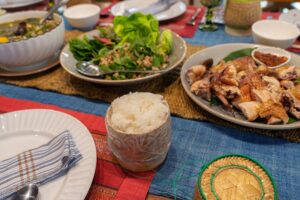
Spread of traditional Lao dishes. Photo: Shutterstock
The food in Luang Prabang is genuinely one of the best reasons to go. Lao cuisine doesn’t get nearly enough attention internationally, and this city is where it’s at its best.
Or lam is the local stew — buffalo or chicken slow-cooked with eggplant, mushrooms, lemongrass, and a native vine called sakhan that gives it a peppery, numbing kick. It’s thick, warming, and completely specific to this place. Laap is the other essential: minced meat with toasted rice powder, lime, mint, and chili. Order the fish version here — the Mekong catch is fresh and it shows. Khai paen is the snack nobody expects to love: river moss dried and pressed into thin sheets with sesame and garlic, flash-fried until crispy. It works.
Mornings in Luang Prabang smell like a French bakery because, in a lot of ways, they are one. Fresh baguettes, strong coffee with condensed milk, pastries at riverside cafes — the colonial legacy left some genuinely good things behind.
For dinner, go to the night market and skip the main souvenir strip. The alley running off to the side is where the actual food is: grilled Mekong fish, or lam from clay pots, sticky rice, and jaew bong — a chili paste with buffalo skin that tastes way better than it sounds. Grab a plate, find a spot, eat well.
Who It’s For
Luang Prabang is for anyone who wants to actually slow down on a trip rather than just say they will. It’s great for couples, for solo travelers who want to wander without a plan, and especially for anyone who has already done Thailand and Vietnam and wants something that feels less touristy and more real. The town doesn’t perform for visitors. It just exists, and right now that’s a rare thing.
Best Time to Visit
November through February is the best window — dry, clear skies, and cool enough in the evenings to actually enjoy being outside. December and January are the busiest months so book ahead. March gets hot and late March can bring haze from agricultural burning in the surrounding mountains. April is the hottest month but it brings Pi Mai — Lao New Year — a three-day celebration with water fights, processions, and temple ceremonies that makes the heat worth it. The rainy season runs May through October: fewer tourists, lower prices, very green landscapes, though August and September see the Mekong running very high.
The Numbers
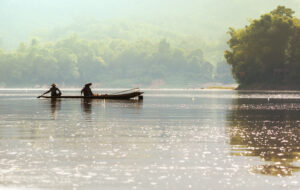
Longtail boatsunset along the Mekong riverbank. Photo: Shutterstock
Flights from Bangkok take around 90 minutes; there are also connections from Hanoi, Singapore, and Chiang Mai. A high-speed rail line launched in December 2021 connects Luang Prabang south to Vientiane — a scenic option worth considering. Guesthouses in the old town start from around 150,000–300,000 LAK (approximately $7–$15 USD) per night; luxury riverside properties start from around $200 USD. Hotels with pools sit just outside the UNESCO-protected historic core. Markets and street stalls are cash-only. Local currency is the Lao Kip (LAK).