
The Sheedi of Pakistan: Afro-Pakistani Culture and Identity
In the villages of Sindh and the streets of Karachi, a community descended from East African ancestors has held onto something remarkable — and most of the world has never heard of them.
By Amina Mamaty | Published on May 26, 2026
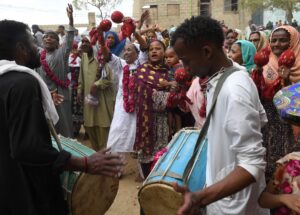
Sheedi playing traditional music during the discontinued Sheedi Mela or Crocodiles festival in Pakistan. Photo by Ashraf Khan
The drumming reaches you before anything else. Deep, rhythmic, unmistakably African — and yet you are standing in the middle of rural Sindh, Pakistan, hours from Karachi, surrounded by flat agricultural land and the kind of quiet that only exists far from cities. Nothing about the landscape suggests what is about to unfold.
Who Are the Sheedi?
The Sheedi — also spelled Sidi, Siddi or Shidi depending on the region — are descendants of Bantu-speaking Africans brought to South Asia between the 7th and 19th centuries, primarily through Arab and Portuguese slave trade routes along the East African coast. Their ancestors came largely from present-day Tanzania, Mozambique and Ethiopia, brought to the subcontinent as enslaved laborers, soldiers, sailors and domestic workers.
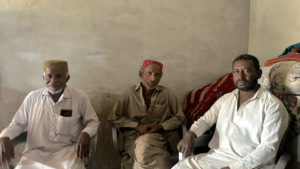
Sheedi elders in Baigpur village, Sindh province. Photo: Young International
Today, Sheedi communities exist across South Asia — in India’s Gujarat and Karnataka states, and most significantly in Pakistan’s Sindh and Balochistan provinces. Estimates suggest between 50,000 and 250,000 Sheedi live in Pakistan, though exact figures are difficult to confirm given how underdocumented this community remains. In Sindh they are concentrated in rural villages like Tando Bago as well as pockets of Karachi. In Balochistan, particularly along the Makran coast, another significant Sheedi population has maintained its own distinct traditions.
Despite centuries of integration into Pakistani society, the Sheedi remain a community apart — recognizable, proud and navigating a complex relationship with belonging.
What Survived — And What Didn’t
It would be easy to romanticize this story. To say that the Sheedi have preserved their African heritage in full — a living museum of East African culture transplanted to South Asia. The reality, as with most diaspora communities shaped by forced displacement, is more complicated and more honest than that.
Most traditions did not survive. The languages are gone. The specific religious practices of their East African ancestors have largely been absorbed into Pakistani Islam. The food, the clothing, the daily rhythms of life are Pakistani. Centuries of integration — chosen and unchosen — have done what centuries of integration inevitably do.
But the drumming survived. And in the drumming, everything survived.
The Sheedi musical tradition — centered on the dhamal, a percussion-driven spiritual practice — is the living thread connecting this community to their East African roots. The rhythms are unmistakably African in origin. The instruments, including large drums called mugarman, bear striking resemblance to those found in Bantu musical traditions across East Africa. And the spiritual intensity of the performance carries something that transcends geography and centuries.
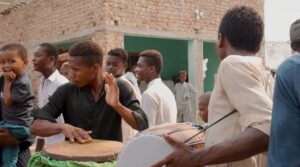
Sheedi community playing the drums in Sindh province. Photo: Manahil Naveed
When the drums begin in Tando Bago, you feel it physically. Not just as music but as something older and deeper — a frequency that bypasses language and explanation entirely. This is a community that has absorbed everything Pakistan offered and still held onto the one thing that could not be translated or replaced.
The Villages
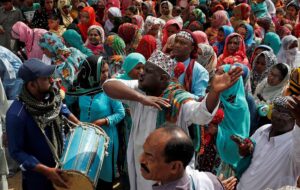
Gathering during the Sheedi Mela Festival. Photo: CGTN
Tando Bago is one of several Sheedi villages clustered in rural Sindh. Moving through them in a single day reveals not just a community but a way of existing — unhurried, deeply rooted and extraordinarily warm to the stranger who arrives with genuine curiosity rather than a camera pointed first.
Tea appears without being asked for. Chairs are arranged in the shade. Children gather at a respectful distance and then, gradually, not so distant. And then the drums come out.
In each village the experience carries the same essential thread — a community that knows exactly who they are and where they come from, even when the wider world does not. The Sheedi of Sindh are not performing their identity for visitors. They are simply living it, and they extend an invitation to witness that with remarkable grace.
How to Encounter the Sheedi Community Respectfully
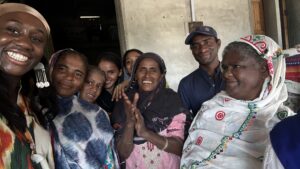
Locals in Baigpur village, Pakistan. Photo: Young International
The Sheedi are not a tourist attraction and should never be approached as one. Engaging with this community thoughtfully requires intention and preparation.
Go with a local connection. The most meaningful way to visit Sheedi villages is through a Pakistani contact — a journalist, a cultural organization, a local guide with genuine community ties — who can make a proper introduction. Arriving without context or connection is not appropriate for a community that has historically been both marginalized and exoticized.
Learn before you arrive. Understanding the basic history of how the Sheedi came to Pakistan — through the East African slave trade, not by choice — is the minimum context every visitor should carry. This is not background information. It is the entire story.
Why This Story Matters
The Sheedi represent one chapter of the African diaspora that the world rarely acknowledges. The history of Africans in South Asia — brought through the Indian Ocean slave trade rather than the Atlantic — sits outside the dominant narrative of how African people were dispersed across the globe. It is a history that deserves to be known, taught and traveled toward.
Within Pakistan itself, the Sheedi community represents a layer of depth that even most Pakistani travelers have never explored. To spend a day in Tando Bago — to hear the drums, to drink the tea, to sit with people whose ancestors crossed an ocean under the worst possible circumstances and who are still here, still drumming, still celebrating — is to encounter something that travel rarely delivers: a story that reframes everything you thought you knew about a place.
You do not expect to find the echo of East Africa in rural Sindh. But there it is, in the drumming, in the faces, in the extraordinary resilience of a community that has survived everything and forgotten nothing that matters.
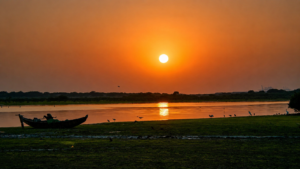
Sun setting over Badin, Pakistan. Photo: Young International
Tando Bago is located in Sindh province, approximately 2.5 hours from Karachi by road. The Lyari neighborhood in Karachi has a historic Sheedi presence and is worth exploring with a knowledgeable local guide. The second significant Sheedi concentration is in Balochistan, particularly around the Makran coastal region.