
Tbilisi’s Sulfur Baths: A Guide to Georgia’s Ancient Bathing Ritual
The smell hits you first. Then the heat. Then you understand why this city was built here in the first place.
By Amina Mamaty | Published on June 1, 2026
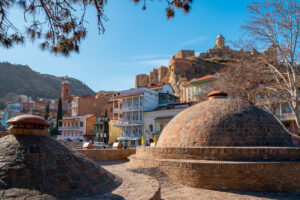
The domed sulfur bathhouses of Abanotubani, Tbilisi
Tbilisi exists because of hot water. In the 5th century, King Vakhtang Gorgasali was out hunting when his falcon dove after a pheasant and both birds disappeared into a narrow gorge. He found them — dead or alive, depending on which version of the story is being told — in a natural hot spring bubbling up from the earth. The king decided a city should be built there. He named it Tbilisi, from the Georgian word meaning “warm place,” and the sulfur springs that created it have been at the center of the city’s culture ever since.
By the 13th century, there were 65 bathhouses in the Abanotubani district — the name translating simply to “bath district.” Marco Polo mentioned them. Alexander Pushkin wrote poetry about them. Alexandre Dumas described the scrub treatment as something that started with the joints of his fingers and involved two people bending his limbs in ways that should have been painful but were somehow the opposite. The baths were where people came to get clean, to socialize, to do business, to gossip, and in the old days — to check out potential daughters-in-law. They were the original third place. Today there are fewer than a dozen left operating. The tradition, the springs, and the architecture are all still there.
The District
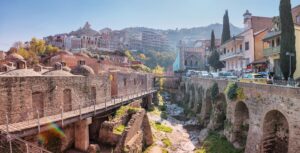
The Tsavkistskali River flowing through the Abanotubani district in Tbilisi. Photo: Shutterstock
Abanotubani sits in a narrow gorge on the eastern bank of the Mtkvari River, tucked at the base of Narikala Fortress. Walking into it feels genuinely different from the rest of Tbilisi — quieter, older, the air carrying a faint mineral warmth even outside. The defining feature is the architecture: low brick domes that rise from the ground like molehills, their rounded tops serving as skylights and ventilation shafts for the chambers below. The bathhouses themselves are underground, built directly over the natural springs so the water arrives already heated and mineral-rich, straight from the source.
The most recognizable building in the district is Chreli-Abano — which translates to “colorful bath” — a stunning facade of blue and turquoise mosaic tiles with Persian-influenced arched windows and stained glass. It looks like it belongs somewhere between Isfahan and Istanbul, which in a way it does: the architecture of Abanotubani reflects the layers of Persian, Ottoman, and Georgian influence that shaped Tbilisi’s history. Even if someone never goes inside a bath, walking through the district at dusk — steam rising from the domes, the fortress lit up above — is one of the better moments Tbilisi offers.
What Actually Happens Inside
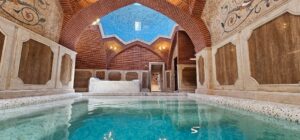
Private bath room at Gulos Thermal Spa in Tbilisi. Photo: Gulos Thermal Spa
A private room at one of Tbilisi’s sulfur baths is booked by the hour and comes with a hot sulfur pool — large enough to fully submerge, naturally heated to around 38–40°C — plus a shower, a stone platform, and depending on the bathhouse and room tier, a cold plunge pool, sauna, and sitting area. The water is clear but carries a distinctly mineral quality — slightly silky, with the unmistakable faint scent of sulfur that becomes, within about ten minutes, completely unnoticeable and then somehow pleasant. There is no chlorine. No additives. Just water that has been rising through the same geological layers for thousands of years.
The private room experience has a rhythm to it: arrive, strip down, soak in the hot pool, move to the cold plunge if there is one, return to the hot pool, repeat. The contrast between the two temperatures is the point — the heat opens everything up; the cold closes it back down. After 20 or 30 minutes of this, the body reaches a state of warm, loose calm that is quite unlike anything produced by a conventional spa. This is not a spa day. It is something older and more physical than that.
The Kisi Scrub
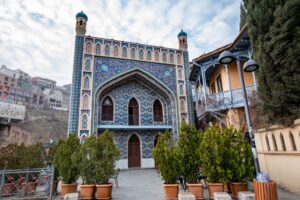
Chreli-Abano & Spa exterior in Tbilisi. Photo: Chreli-Abano & Spa
At some point during the soak, there will be a knock at the door. This is the Mekise — the person who performs the kisi scrub — and it is the part of the experience worth doing even if nothing else sounds appealing. The kisi is Georgia’s version of the hammam exfoliation treatment: a textured mitt worked firmly across every surface of the body, removing dead skin in a quantity that is simultaneously alarming and deeply satisfying. It takes 10 to 15 minutes, followed by a soapy foam wash and a rinse. The Mekise is paid separately in cash — typically 10 to 20 GEL ($3 to $8.)
What comes after the kisi is the best part: the skin feels genuinely new. The combination of the mineral water and the exfoliation produces a softness that no product available for purchase replicates. Most people who skip the kisi on the first visit book it immediately for the second.
Which Bath to Choose
Tbilisi has around ten functioning sulfur baths, almost all within walking distance of each other in Abanotubani. For a first visit, two stand out consistently.
Chreli-Abano — also known as the Orbeliani Baths — is the one with the extraordinary tiled facade. The private rooms range from compact single-person spaces to larger suites with cold plunge, sauna, and lounge area. It books out, especially on weekends, so reserving online a few days ahead is worth doing.
Gulo’s Thermal Spa is the other consistent recommendation, and YIM’s Editor-in-Chief’s personal favorite. It is more understated from the outside but considered one of the best private bath experiences in the city, with beautifully maintained rooms and attentive service. Popular with both locals and visitors who know what they are doing.
For a more traditional, local-facing experience, Bath No. 5 still has public gender-segregated rooms where the ritual is less about luxury and more about the water itself — exactly what these baths were built for.
What to Know Before Going
The baths are open daily, typically from early morning through late evening. Private rooms are charged by the hour and range from around 60–120 GEL ($23-$45) for a basic room to 300 GEL ($112) and above for larger, more luxurious suites. Weekends fill up — book ahead. Bring flip flops for the shower. The kisi is paid in cash to the Mekise, separately from the room fee. Towels are usually provided but a swimsuit is required in private rooms. Nothing needs to be brought except a willingness to sit in hot sulfur water for an hour and come out feeling significantly better than before.
Who It’s For
Everyone. Genuinely. The sulfur baths work for solo travelers who want an hour of heat and quiet in the middle of a busy trip. For couples who want something more intimate and interesting than a hotel spa. For groups who can split a large private room and have the whole space to themselves for the price of a round of drinks. The experience scales across all of these — what stays constant is the water, the warmth, and the particular kind of reset that comes from spending an hour in the place this city was built around.
Best Time to Go
The baths are open year-round and are honestly best in winter, when stepping out of the cold Tbilisi air into a room of hot mineral water is one of the better decisions a traveler can make. Summer works too, though the contrast between the heat outside and the heat inside requires commitment. Mornings on weekdays are the quietest; weekend evenings require booking well in advance.
Getting There
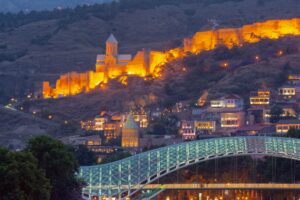
Old Town of Tbilisi by night. Photo: Shutterstcok
Abanotubani is in the Old Town of Tbilisi, a short walk from the Metekhi Bridge and easily reached by taxi or on foot from most central neighborhoods. Bolt and Yandex are the standard ride apps. The district is walkable and compact — most bathhouses are within a few minutes of each other. Local currency is Georgian Lari (GEL); the kisi is always cash only, and smaller bathhouses may prefer cash for the room as well.