
Traditional Mongolian Food: 5 Dishes You Have to Try
Mongolian food is built for survival.
By Amina Mamaty | Published on May 25, 2026
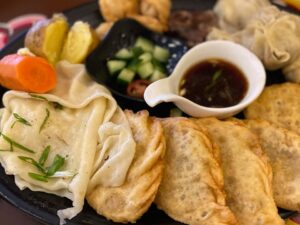
Mongolian food. Photo: Shutterstock
Eat in Mongolia long enough and a pattern emerges. Everything on the table exists for a reason. Meat because the steppe provides it. Dairy because the animals are right outside. Starch because the cold demands fuel. Mongolian cuisine is not trying to impress you — it is trying to sustain you, the way it has sustained nomadic families across one of the harshest landscapes on earth for thousands of years. Come with an open mind, eat what is put in front of you, and let the context do the seasoning.
Here are the dishes that define the table.
Buuz
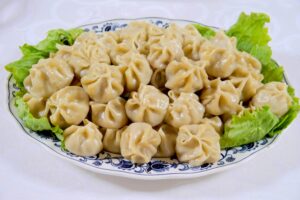
Raw hand-folded, uncooked buuz. Photo: Shutterstock
If Mongolia has a national dish, it is buuz. These plump, hand-folded steamed dumplings — filled with minced mutton or beef, sometimes with onion and garlic — appear at almost every meal and every occasion. They are eaten by hand, which is the only correct way, and they arrive hot enough to demand patience. The dough is thick and slightly chewy, the filling dense and savory. Buuz are made in enormous quantities during Tsagaan Sar, the Mongolian Lunar New Year, when families will steam hundreds at a time to share with guests. Eating them in a nomadic family’s ger, passed across a painted table while the stove crackles in the center of the room, is a different experience entirely from eating them anywhere else.
Khuushuur
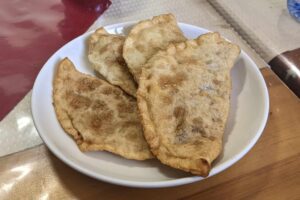
Golden fried khuushuur. Photo: Shutterstock
Think of khuushuur as buuz’s fried cousin — the same meat filling, but sealed into a flat pastry and deep-fried until golden and slightly crisp on the outside. It is Mongolia’s street food, its festival food, its casual afternoon food. During Naadam, khuushuur vendors set up around the stadium and the smell alone is enough to pull you in. They are best eaten immediately, while still hot, with both hands and no apology. The outside shatters slightly when you bite in. The inside is rich and satisfying in a way that makes sense after a morning on horseback or a long drive across the steppe.
Tsuivan
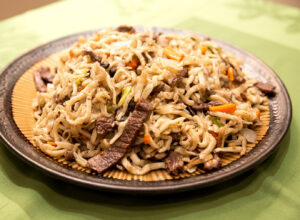
Tsuivan, thick hand-pulled noodles tangled with strips of beef and vegetables. Photo: Shutterstock
Tsuivan is stir-fried noodles — hand-pulled, thick, and tangled together with strips of meat and whatever vegetables are available. It is a one-pot dish in the best sense: filling, warming, and completely unpretentious. The noodles are made fresh, cooked first by steaming and then finished in the pan with meat fat and broth. It is the kind of food that fills you in a way that lasts, which is exactly the point. Tsuivan turns up at ger camp restaurants and family tables alike, and it is one of the most approachable dishes for first-time visitors to Mongolian food.
Suutei Tsai
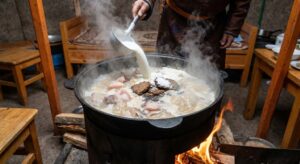
Nomadic cooking tradition, with pot over an open fire inside a ger. Photo: Shutterstock
Before you eat anything in Mongolia, you will likely be offered suutei tsai — salted milk tea. It is the first gesture of welcome in a nomadic home and the constant companion of every meal. Brewed from black tea, water, fresh milk, and salt, it is an acquired taste for visitors more accustomed to sweet tea, but one worth acquiring. The salt is not subtle. The milk gives it a richness that makes it more sustaining than any cup of tea has a right to be. Accept every cup offered to you. Refusing is considered impolite, and besides — in the context of a Mongolian ger on a cold morning with the steppe stretching out in every direction, it tastes exactly right.
Airag
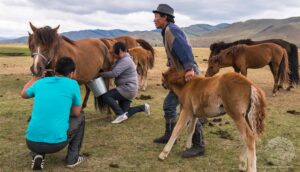
Nomadic family milking a mare on the open steppe. Photo: Shutterstock
Airag is fermented mare’s milk — made from the milk of horses, left to ferment until it becomes slightly fizzy, faintly sour, and vaguely alcoholic. It is Mongolia’s most culturally significant drink, offered at celebrations, festivals, and family gatherings across the country. It is also, to be honest, one of the more challenging things a first-time visitor will put in their mouth. Slightly sour, slightly carbonated, and genuinely difficult to finish — airag is the kind of drink you try once and remember forever, whether you want to or not.
What many visitors don’t know is that airag has long been used in Mongolia as a digestive cure and detox drink, with some people undertaking full airag treatments during summer. The takeaway for travelers: try it, appreciate it, honor it — but don’t go overboard. Your stomach will thank you.
A note for first-timers: Mongolian food rewards openness. It is hearty and honest and built for a life that most visitors have never lived. It will not always be what you expected. Eat it where it’s made — in a ger, at a camp, at a family table — and it will be unforgettable. That’s the whole secret.