
A First-Timer’s Guide to Uruguay: What to Know Before You Go
Uruguay borders Argentina and Brazil, costs less than both, and barely appears on the average South America itinerary. This Uruguay travel guide covers everything first-time visitors should know, from transportation, beaches, and culture.
By Cynthia David | Published on June 3, 2026
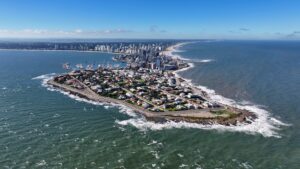
Punta Del Este, Urugay skyline. Photo: Shutterstock
When people think about South America, their mind goes straight to Peru, Brazil, Argentina, and Colombia. Uruguay sits between Argentina and Brazil, covers just over 176,000 square kilometers making it the second smallest country on the continent, and has some of the best beaches, most intact colonial architecture, and most relaxed travel atmosphere in the region. It does not get the foot traffic its neighbors do. That is changing, and now is the right time to go.
Getting There

Ferry departing from Buenos Aires to Montevideo. Photo: Open Ferry
The majority of travelers reach Uruguay by ferry from Buenos Aires. The crossing takes 75 minutes across the Rio de la Plata and costs approximately $100 USD round trip, with cheaper fares available on weekdays. It saves around $150 to $200 compared to flying directly and is the more scenic and practical option for anyone already passing through Argentina.
For those flying directly, the entry point is Carrasco International Airport in Montevideo, about 20 to 30 minutes from the city center. Seasonal direct flights operate from Miami. American Airlines, LATAM, United, and Copa Airlines all service the route, with flight times ranging from 9 to 11 hours depending on connections.
US citizens do not need a visa for stays of up to 90 days. A passport valid for at least six months past the entry date is required, with at least one blank page for stamps.
Money, Language and Safety
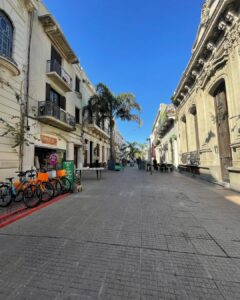
Montevideo street. Photo: Cynthia David
Uruguay uses the Uruguayan Peso. One USD equals approximately 40 Uruguayan Pesos at the time of writing. Major credit cards are accepted widely across the country, but having a small amount of local cash on hand is worth it. USD is accepted in most establishments, though change will typically come back in pesos.
Uruguay is one of the more expensive countries in South America. A comfortable day runs between $50 and $100 USD per person. It is not a backpacker destination, and the price reflects a country with strong infrastructure, high safety standards, and a quality of life that is visible on the ground.
Spanish is the official language. Learning a few basic phrases before arriving goes a long way. Locals respond warmly to visitors who make the effort, even when the Spanish is clearly a work in progress. A translation app is a reliable backup.
In terms of safety, Uruguay is consistently ranked among the safest countries in Latin America. Standard precautions apply: stay aware of surroundings, keep valuables secured, and stick to well-lit areas at night.
When to Go
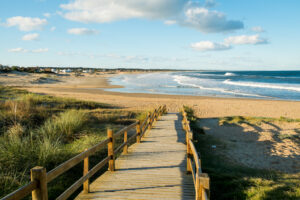
La Pedrera beach. Photo: Shutterstock
Uruguay runs on reversed seasons relative to the Northern Hemisphere. December through February is summer and peak season, the best time for beaches in Punta del Este. Prices are highest and crowds are at their fullest in December and January when the whole region is on holiday.
March through May brings autumn. Crowds thin, prices drop, and the weather stays pleasant. It is one of the better windows for a first visit if the beaches are not the main draw.
June through August is winter, with temperatures between 45 and 60 degrees Fahrenheit. This is the cheapest time to visit and the quietest. Popular sites are easy to move through without crowds.
September through November is spring, with temperatures from 55 to 70 degrees. This is the window for anyone interested in hiking or spending time in the countryside beyond the major cities.
Punta del Este
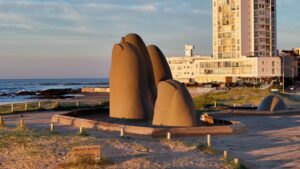
La Mano statue in Montevideo. Photo: Shutterstock
For beaches, Punta del Este is the destination. Playa Mansa is the calmer, family-friendly option on the protected bay side of the peninsula. Playa Brava, on the ocean side, is where the waves are fierce and the energy matches. Surfing, food, and people-watching all happen here. Bikini Beach sits between the two in terms of atmosphere and draws a more social crowd.
The La Mano statue is the landmark that defines Punta del Este: a giant hand emerging from the sand, built as a tribute to local sailors lost at sea. It is one of those images that makes immediate sense once you are standing in front of it.
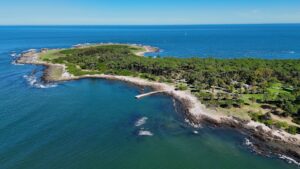
Isla Gorriti. Photo: Shutterstock
From Punta del Este, day trips by boat reach Isla Gorriti, a small island walkable in about an hour, and Isla de los Lobos, five miles offshore, home to one of the largest sea lion colonies in this part of the world. Swimming alongside them off the island’s shore is possible and entirely worth it.
Colonia del Sacramento
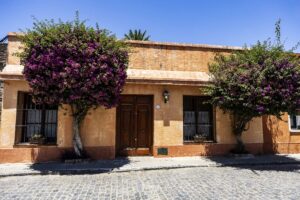
Colonia del Sacramento cobblestone streets. Photo: Shutterstock
Colonia del Sacramento is a UNESCO World Heritage Site and one of the most intact examples of 17th-century colonial architecture in South America. The Barrio Histórico, the historic quarter, is compact enough to cover on foot in a day. Calle de los Suspiros, the Street of Sighs, is the most photographed stretch in the city and earns the attention. The ruins of the San Francisco Xavier convent and the Colonia del Sacramento Lighthouse are both worth the time. Colonia works well as a day trip from Montevideo or as a quiet overnight stop.
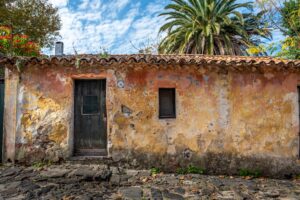
House from the 17th century in Colonia del Sacramento. Photo: Shutterstock
Montevideo
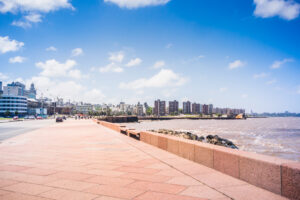
Rambla waterfront in Montevideo. Photo: Shutterstock
Montevideo is the capital and the cultural center of Uruguay. Ciudad Vieja, the old town, holds the history: museums, galleries, and colonial-era squares including Plaza Independencia and Plaza Constitución. The Mirador Panorámico de la Intendencia offers 360-degree views of the city from the 22nd floor. The Rambla, the waterfront boardwalk that stretches along the Rio de la Plata, is one of the longest in the world and one of the best ways to spend an afternoon in the city. Mercado del Puerto, the port market, is the place to eat: a covered food hall with open grills and a full range of Uruguayan cuisine in one space.
The people of Uruguay are welcoming and openly proud of their country. First-time visitors consistently remark on how easy it is to move through, how approachable the locals are, and how much the country delivers beyond what they expected going in.
The Numbers
Uruguay uses the Uruguayan Peso, with 1 USD equal to approximately 40 pesos. A comfortable mid-range day runs $50 to $100 USD per person covering accommodation, meals, and local transport. The Buenos Aires to Montevideo ferry costs approximately $100 USD round trip, with cheaper weekday fares available. Round-trip flights from the US range from $700 to $1,200 USD depending on the season and routing. Carrasco International Airport sits 20 to 30 minutes from central Montevideo. US citizens can stay visa-free for up to 90 days.